

Article Sidebar
Main Article Content
Abstract
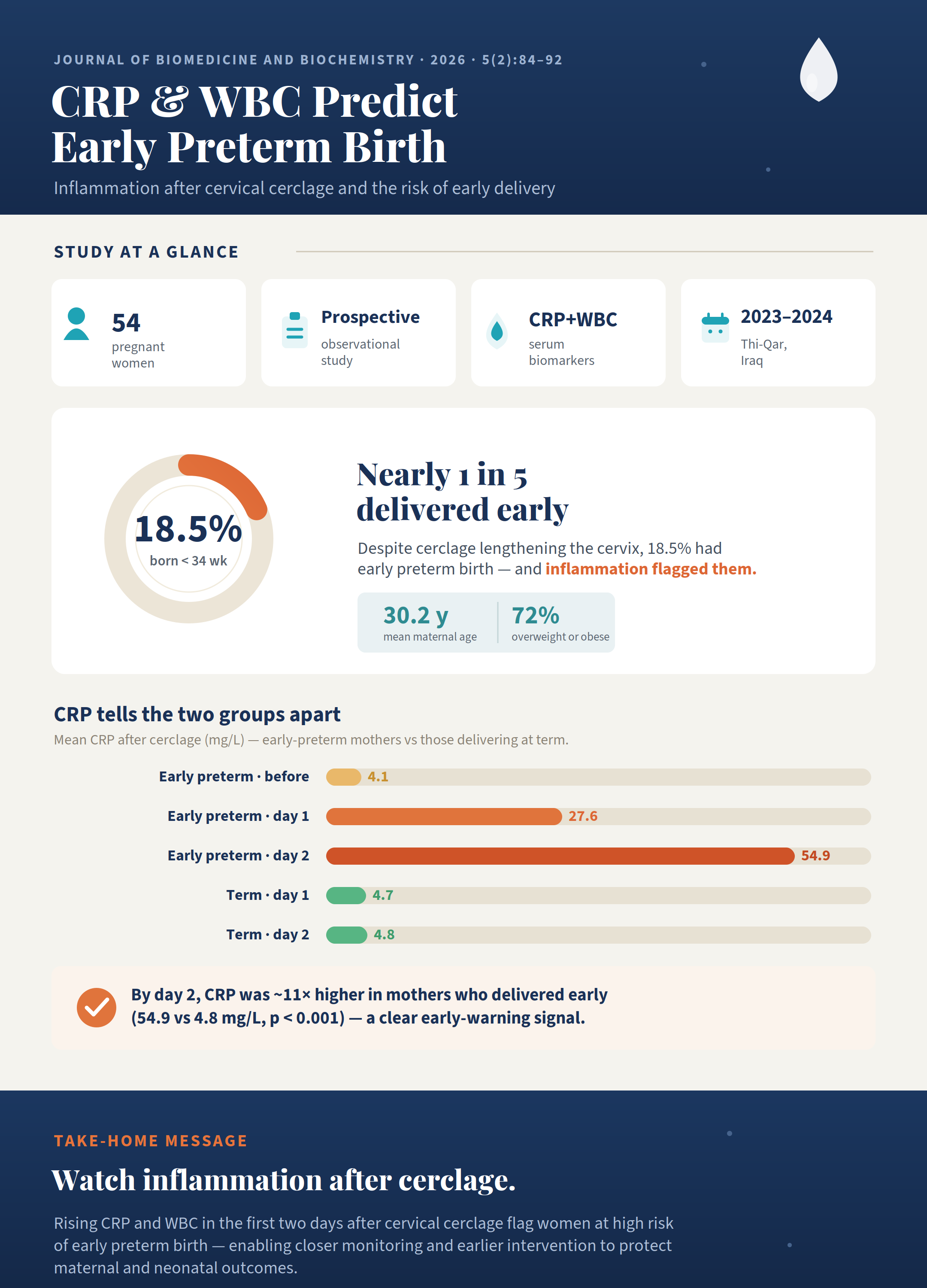
Background and Aim: Preterm birth affects over 15 million infants annually worldwide, with cervical insufficiency being a major contributing factor. This study evaluates CRP and WBC levels in pregnant women undergoing cervical cerclage to predict Early Preterm Birth (EPTB) risk.
Methods: A prospective observational study conducted at Bint al-Huda Hospital, Thi-Qar, Iraq, from December 2023 to December 2024. Fifty-four pregnant women with singleton pregnancies and cervical insufficiency (cervical length <25 mm) were enrolled. CRP and WBC levels were measured pre-cerclage and on days 1 and 2 post-cerclage, with follow-up until delivery.
Results: Mean participant age was 30.2 years. Cervical length improved from 20.6 mm pre-cerclage to 23.8 mm post-cerclage. Mean gestational age at cerclage was 20.6 weeks, with delivery occurring at a mean of 35.3 weeks. Only 18.5% delivered before 34 weeks, while 81.5% delivered at or beyond 34 weeks. Elevated pre-cerclage CRP and WBC levels were significantly associated with increased EPTB risk. Post-cerclage monitoring identified persistent inflammation correlating with adverse outcomes.
Conclusions: CRP and WBC are reliable biomarkers for predicting EPTB in women undergoing cervical cerclage. Elevated pre-cerclage levels indicate higher risk, necessitating close monitoring and early intervention. Post-cerclage trends provide critical insights into inflammatory responses, enabling targeted management to improve maternal and neonatal outcomes. Further research is recommended to refine predictive models and explore therapeutic strategies.
Keywords
Article Details
Copyright (c) 2026 Nawar Hasan Jaaz, Alaa Hussein Ali Nasser (Author)

This work is licensed under a Creative Commons Attribution 4.0 International License.
How to Cite


References
- American Collegeof Obstetricians and Gynecologists. ACOG Practice Bulletin No. 142: Cerclage for the management of cervical insufficiency. Obstet Gynecol. 2014;123(2 Pt 1):372–379. https://doi.org/10.1097/01.AOG.0000443276.68274.cc
- Al-Dabbagh SA, Al-Taee WY. Risk factors for pre-term birth in Iraq: a case-control study. BMC Pregnancy Childbirth. 2006;6:13. https://doi.org/10.1186/1471-2393-6-13
- Alfirevic Z, Milan SJ, Livio S. Caesarean section versus vaginal delivery for preterm birth in singletons. Cochrane Database Syst Rev. 2013;(9):CD000078. https://doi.org/10.1002/14651858.CD000078.pub3
- Alfirevic Z, Stampalija T, Medley N. Cervical stitch (cerclage) for preventing preterm birth in singleton pregnancy. Cochrane Database Syst Rev. 2017;6(6):CD008991. https://doi.org/10.1002/14651858.CD008991.pub3
- Almaghaslah EH, Al Ibrahim I, Al-Zahir SS, Al Saif AZ. Prevalence of preterm birth in Saudi Arabia: a systematic review and meta-analysis. Cureus. 2024;16(11):e74562. https://doi.org/10.7759/cureus.74562
- Al-Musawi HH. Epidemiological study of premature neonate in Baghdad [Internet]. Baghdad (IQ): University of Baghdad; 2023
- American College of Obstetricians and Gynecologists. Practice Bulletin No. 171: Management of preterm labor. Obstet Gynecol. 2016;128(4):e155–164. https://doi.org/10.1097/AOG.0000000000001711
- Amezcua-Castillo E, González-Pacheco H, Sáenz-San Martín A, et al. C-reactive protein: the quintessential marker of systemic inflammation in coronary artery disease. Biomedicines. 2023;11(9):2444. https://doi.org/10.3390/biomedicines11092444
- World Health Organization. Preterm birth [Internet]. 2024
- Royal College of Obstetricians and Gynaecologists. Green-top guidelines: compendium of guidelines. London: RCOG; 2022.
- Wekere FCC, Clement-Wekere GAF, Nonye-Enyidah EI. Cervical incompetence: prevalence, socio-demographic and clinical characteristics. Yen Med J. 2020;2(1):127–134.
- Hulshoff CC, Bosgraaf RP, Spaanderman MEA, et al. The efficacy of emergency cervical cerclage in singleton and twin pregnancies: a systematic review with meta-analysis. Am J Obstet Gynecol MFM. 2023;5(7):100971. https://doi.org/10.1016/j.ajogmf.2023.100971
- Huang X, Chen R, Li B. Analysis of maternal and neonatal outcomes using cervical cerclage or conservative treatment in singleton gestations with a sonographic short cervix. Medicine (Baltimore). 2021;100(18):e25767. https://doi.org/10.1097/MD.0000000000025767
- Persson M, Pasupathy D, Hanson U, et al. Pre-pregnancy BMI and the risk of adverse outcome in type 1 diabetic pregnancies: a population-based cohort study. BMJ Open. 2012;2(1):e000601. https://doi.org/10.1136/bmjopen-2011-000601
- Fan X, Ma Y, Zhu Y, et al. The potential presence of infection may be indicated through non-invasive prediction of procalcitonin and C-reactive protein levels within the initial three days after cervical cerclage. BMC Pregnancy Childbirth. 2024;24(1):474. https://doi.org/10.1186/s12884-024-06668-9
- Lee K-N, Yun S, Park S-Y, et al. Factors associated with spontaneous preterm birth after ultrasound-indicated cerclage. J Pers Med. 2023;13(12):1678. https://doi.org/10.3390/jpm13121678
- Gomez-Lopez N, Galaz J, Miller D, et al. The immunobiology of preterm labor and birth: intra-amniotic inflammation or breakdown of maternal–fetal homeostasis. Reproduction. 2022;164(2):R11–R45. https://doi.org/10.1530/REP-22-0046
- Najat Nakishbandy BM, Barawi SA. C-reactive protein in premature uterine contractions. J Prenat Med. 2014;8(1-2):25–30.
- Wei M, Jin X, Li TC, et al. A comparison of pregnancy outcome of modified transvaginal cervicoisthmic cerclage performed prior to and during pregnancy. Arch Gynecol Obstet. 2018;297(3):645–652. https://doi.org/10.1007/s00404-017-4636-x
References
American Collegeof Obstetricians and Gynecologists. ACOG Practice Bulletin No. 142: Cerclage for the management of cervical insufficiency. Obstet Gynecol. 2014;123(2 Pt 1):372–379. https://doi.org/10.1097/01.AOG.0000443276.68274.cc
Al-Dabbagh SA, Al-Taee WY. Risk factors for pre-term birth in Iraq: a case-control study. BMC Pregnancy Childbirth. 2006;6:13. https://doi.org/10.1186/1471-2393-6-13
Alfirevic Z, Milan SJ, Livio S. Caesarean section versus vaginal delivery for preterm birth in singletons. Cochrane Database Syst Rev. 2013;(9):CD000078. https://doi.org/10.1002/14651858.CD000078.pub3
Alfirevic Z, Stampalija T, Medley N. Cervical stitch (cerclage) for preventing preterm birth in singleton pregnancy. Cochrane Database Syst Rev. 2017;6(6):CD008991. https://doi.org/10.1002/14651858.CD008991.pub3
Almaghaslah EH, Al Ibrahim I, Al-Zahir SS, Al Saif AZ. Prevalence of preterm birth in Saudi Arabia: a systematic review and meta-analysis. Cureus. 2024;16(11):e74562. https://doi.org/10.7759/cureus.74562
Al-Musawi HH. Epidemiological study of premature neonate in Baghdad [Internet]. Baghdad (IQ): University of Baghdad; 2023
American College of Obstetricians and Gynecologists. Practice Bulletin No. 171: Management of preterm labor. Obstet Gynecol. 2016;128(4):e155–164. https://doi.org/10.1097/AOG.0000000000001711
Amezcua-Castillo E, González-Pacheco H, Sáenz-San Martín A, et al. C-reactive protein: the quintessential marker of systemic inflammation in coronary artery disease. Biomedicines. 2023;11(9):2444. https://doi.org/10.3390/biomedicines11092444
World Health Organization. Preterm birth [Internet]. 2024
Royal College of Obstetricians and Gynaecologists. Green-top guidelines: compendium of guidelines. London: RCOG; 2022.
Wekere FCC, Clement-Wekere GAF, Nonye-Enyidah EI. Cervical incompetence: prevalence, socio-demographic and clinical characteristics. Yen Med J. 2020;2(1):127–134.
Hulshoff CC, Bosgraaf RP, Spaanderman MEA, et al. The efficacy of emergency cervical cerclage in singleton and twin pregnancies: a systematic review with meta-analysis. Am J Obstet Gynecol MFM. 2023;5(7):100971. https://doi.org/10.1016/j.ajogmf.2023.100971
Huang X, Chen R, Li B. Analysis of maternal and neonatal outcomes using cervical cerclage or conservative treatment in singleton gestations with a sonographic short cervix. Medicine (Baltimore). 2021;100(18):e25767. https://doi.org/10.1097/MD.0000000000025767
Persson M, Pasupathy D, Hanson U, et al. Pre-pregnancy BMI and the risk of adverse outcome in type 1 diabetic pregnancies: a population-based cohort study. BMJ Open. 2012;2(1):e000601. https://doi.org/10.1136/bmjopen-2011-000601
Fan X, Ma Y, Zhu Y, et al. The potential presence of infection may be indicated through non-invasive prediction of procalcitonin and C-reactive protein levels within the initial three days after cervical cerclage. BMC Pregnancy Childbirth. 2024;24(1):474. https://doi.org/10.1186/s12884-024-06668-9
Lee K-N, Yun S, Park S-Y, et al. Factors associated with spontaneous preterm birth after ultrasound-indicated cerclage. J Pers Med. 2023;13(12):1678. https://doi.org/10.3390/jpm13121678
Gomez-Lopez N, Galaz J, Miller D, et al. The immunobiology of preterm labor and birth: intra-amniotic inflammation or breakdown of maternal–fetal homeostasis. Reproduction. 2022;164(2):R11–R45. https://doi.org/10.1530/REP-22-0046
Najat Nakishbandy BM, Barawi SA. C-reactive protein in premature uterine contractions. J Prenat Med. 2014;8(1-2):25–30.
Wei M, Jin X, Li TC, et al. A comparison of pregnancy outcome of modified transvaginal cervicoisthmic cerclage performed prior to and during pregnancy. Arch Gynecol Obstet. 2018;297(3):645–652. https://doi.org/10.1007/s00404-017-4636-x