

Article Sidebar
Main Article Content
Abstract
Dear Editor,
I read with great interest the recent review by Obaid, “Emerging RNA Viruses: Epidemiology, Pathogenesis, and Challenges for Vaccine Development” [1]. The review offers a timely and well-organized synthesis of the structural and epidemiological features that make RNA viruses disproportionately likely to emerge as zoonotic threats, and its discussion of bunyaviruses and viral hemorrhagic fevers as a recognized category of emerging pathogens is a valuable contribution to a readership working across the biomedical and biochemical sciences.
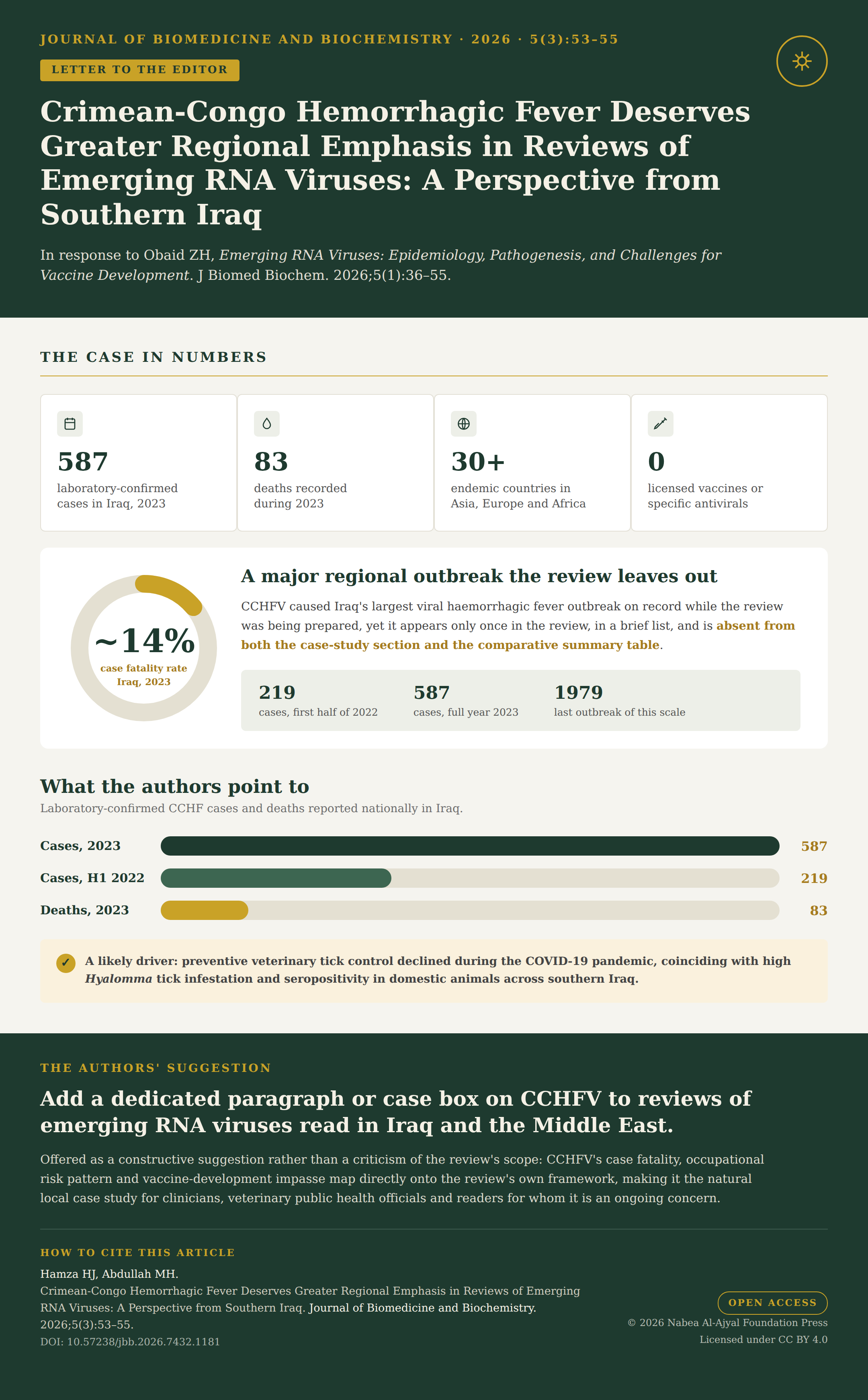
I write to suggest that a more prominent, regionally grounded example within this category would further strengthen the review's relevance to its predominantly Iraqi and Middle Eastern readership. Crimean-Congo hemorrhagic fever virus (CCHFV), a tick-borne member of the order Bunyavirales, appears only once in the review, in a brief list of viruses relevant to a separate national research agenda, and is absent from both the dedicated case-study section covering Ebola and Chikungunya and the summary table comparing epidemiological trends, pathogenesis, and vaccine status across six major RNA viruses. Yet CCHFV has produced the largest and most sustained outbreak of a viral hemorrhagic fever in Iraq's recorded history over exactly the period during which this review was prepared [2]. Confirmed cases rose from 219 in the first half of 2022, the largest outbreak recorded in the country since 1979, to 587 laboratory-confirmed cases with 83 deaths across all of 2023, an overall case fatality rate of approximately 14% [3]. Notably, this is not a distant epidemiological statistic: Babil governorate accounted for the largest single share of national cases in the initial 2022 outbreak (39.7% of all confirmed cases nationally), and a dedicated retrospective investigation has since documented 290 confirmed cases in Babil province alone across 2022-2023, with a case fatality rate of 15.5% concentrated heavily among housewives and those with occupational animal contact [4].
This regional burden is compounded by the specific vaccine development challenges that CCHFV presents, and which align closely with the review's stated focus: no licensed vaccine or specific antiviral therapy is currently available anywhere in the world, despite the virus's wide endemic distribution across more than 30 countries in Asia, Europe, and Africa and its designation by the World Health Organization as a priority pathogen [2]. A retrospective analysis of the 2022-23 Iraqi outbreaks further identified a plausible mechanistic driver behind the recent surge, namely a reduction in preventive veterinary tick-control activities during the COVID-19 pandemic, coinciding with high Hyalomma tick infestation and seropositivity in domestic animals across southern Iraq [5]. This human-animal-environmental interface is precisely the kind of case study that could illustrate, with immediate local relevance, the review's broader arguments about the ecological and agricultural drivers of RNA virus emergence.
I raise this not as a criticism of the review's scope, which necessarily could not cover every emerging RNA virus family in comparable depth, but as a constructive suggestion: given that CCHF is arguably the most consequential emerging RNA viral disease currently active in this region, and given that its case fatality rate, occupational risk pattern, and vaccine-development impasse map so directly onto the review's own framework, a dedicated paragraph or case box on CCHFV would meaningfully increase the review's value to local clinicians, veterinary public health officials, and readers across the wider Middle Eastern region for whom this is an active, ongoing concern rather than a historical example.
I thank the author for a stimulating and well-referenced contribution, and I hope this perspective is useful for future work on this important topic.
Sincerely,
Article Details
Copyright (c) 2026 Hiba Jasim Hamza*, Mutaman Hussein Abdullah (Author)

This work is licensed under a Creative Commons Attribution 4.0 International License.
How to Cite


References
- Obaid ZH. Emerging RNA viruses: epidemiology, pathogenesis, and challenges for vaccine development: review. J Biomed Biochem. 2026;5(1):36-55. https://doi.org/10.57238/jbb.2026.7432.1163
- Hawman DW, Feldmann H. Crimean-Congo haemorrhagic fever virus. Nat Rev Microbiol. 2023;21(7):463-77. https://doi.org/10.1038/s41579-023-00871-9
- Alhilfi RA, Khaleel HA, Raheem BM, Mahdi SG, Tabche C, Rawaf S. Large outbreak of Crimean-Congo haemorrhagic fever in Iraq, 2022. IJID Reg. 2023;6:76-9. https://doi.org/10.1016/j.ijregi.2023.01.007
- Hmmod A, Abdulhameed M, Hussein A, Khudhair N, AL-Adhadh B. Retrospective investigation of Crimean-Congo haemorrhagic fever (CCHF) in Thi-Qar province from year 2022 to 2023. Basrah J Vet Res. 2025;24(1):88-99. https://doi.org/10.23975/bjvr.2025.155858.1177
- Shaker DA, Abd MT, Alsalih NJ, Mahdi SG, Alsaadawi M, Aakef IR, et al. A retrospective study of Crimean-Congo hemorrhagic fever in Iraq. Afr Health Sci. 2024;24(1):59-68. https://doi.org/10.4314/ahs.v24i1.8
References
Obaid ZH. Emerging RNA viruses: epidemiology, pathogenesis, and challenges for vaccine development: review. J Biomed Biochem. 2026;5(1):36-55. https://doi.org/10.57238/jbb.2026.7432.1163
Hawman DW, Feldmann H. Crimean-Congo haemorrhagic fever virus. Nat Rev Microbiol. 2023;21(7):463-77. https://doi.org/10.1038/s41579-023-00871-9
Alhilfi RA, Khaleel HA, Raheem BM, Mahdi SG, Tabche C, Rawaf S. Large outbreak of Crimean-Congo haemorrhagic fever in Iraq, 2022. IJID Reg. 2023;6:76-9. https://doi.org/10.1016/j.ijregi.2023.01.007
Hmmod A, Abdulhameed M, Hussein A, Khudhair N, AL-Adhadh B. Retrospective investigation of Crimean-Congo haemorrhagic fever (CCHF) in Thi-Qar province from year 2022 to 2023. Basrah J Vet Res. 2025;24(1):88-99. https://doi.org/10.23975/bjvr.2025.155858.1177
Shaker DA, Abd MT, Alsalih NJ, Mahdi SG, Alsaadawi M, Aakef IR, et al. A retrospective study of Crimean-Congo hemorrhagic fever in Iraq. Afr Health Sci. 2024;24(1):59-68. https://doi.org/10.4314/ahs.v24i1.8