

Article Sidebar
Main Article Content
Abstract
Background: Hyperlipidemia is marked by reduced high-density lipoprotein and elevated triglycerides, total cholesterol, and low-density lipoprotein cholesterol. It begins with endothelial damage, triggering inflammation and lipid accumulation in artery walls, leading to fibrous plaques that may rupture and cause thrombosis or arterial blockage, worsening cardiovascular disease. Management includes lifestyle changes and drugs such as statins, fibrates, niacin, PCSK9 inhibitors, and ezetimibe.
Aim: To examine the relationship between hyperlipidemia and age and gender, identify risk factors and health consequences, and provide preventive and therapeutic insights.
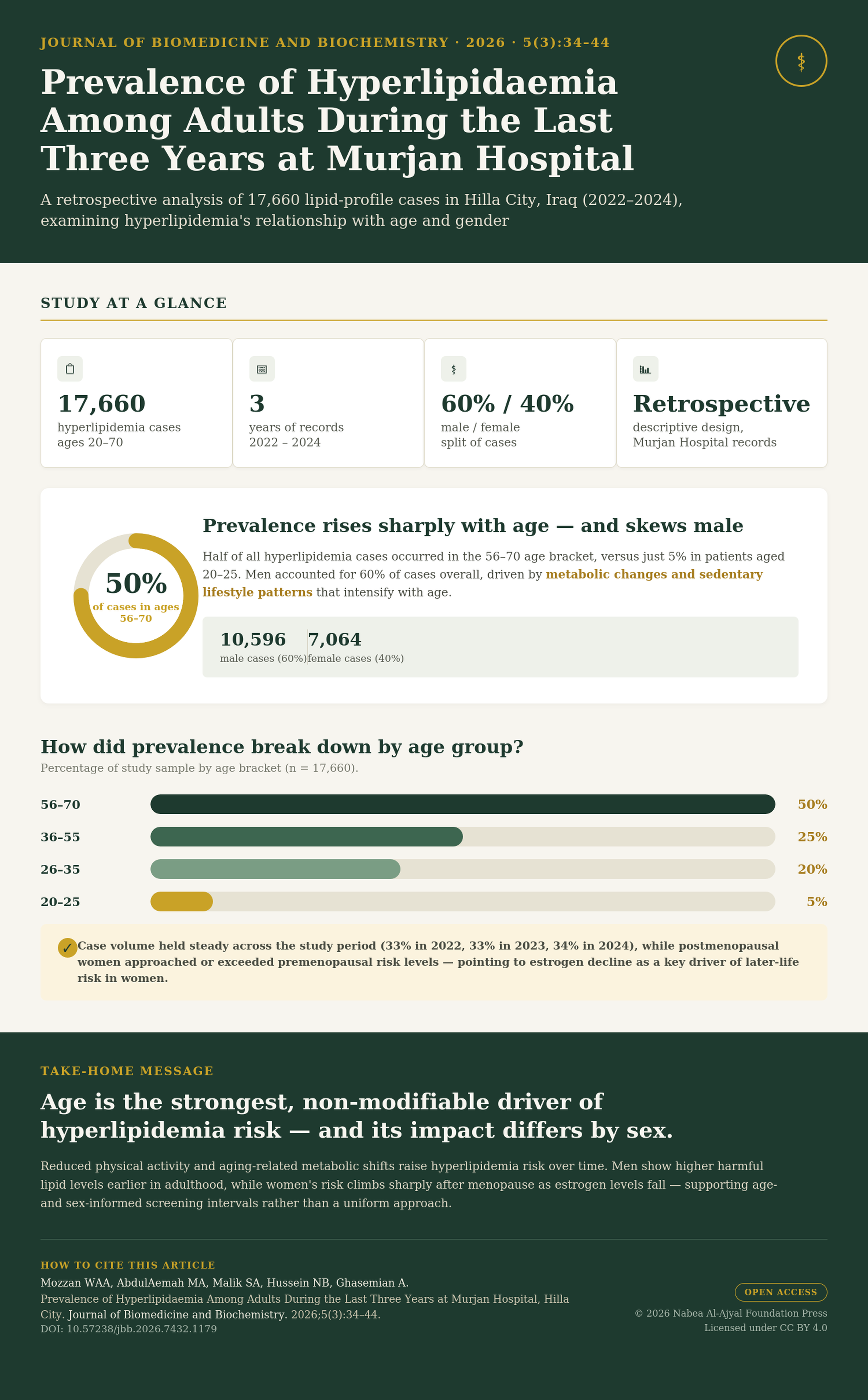
Materials and Methods: This retrospective study analyzed 17,660 adults (aged 20–70) with hyperlipidemia—7,064 females and 10,596 males—using laboratory records from Murjan Hospital in Hilla City (2022–2024). Data were assessed using descriptive statistics (frequencies and percentages).
Results: Cases were distributed as 33% (2022), 33% (2023), and 34% (2024). Lipid abnormalities were notably more frequent in older than younger age groups. Of the total sample, 7,064 (40%) were female and 10,596 (60%) were male.
Conclusion: Hyperlipidemia is linked to age and gender. Aging-related metabolic changes and reduced physical activity increase risk, while men show higher harmful lipid levels during early and mid-adulthood.
Keywords
Article Details
Copyright (c) 2026 Widad Abd Aljabbar Mozzan*, Maytham Ahmed AbdulAemah, Malik Samir Azzat, Nadhema Bahaa Hussein, Abdolmajid Ghasemian (Author)

This work is licensed under a Creative Commons Attribution 4.0 International License.
How to Cite


References
- Berberich AJ, Hegele RA. A modern approach to dyslipidemia. Endocr Rev. 2022;43(4):611–653. doi: 10.1210/endrev/bnab037.
- Schade DS, Shey L, Eaton RP. Cholesterol review: a metabolically important molecule. Endocr Pract. 2020;26(12):1514–1523. https://doi.org/10.4158/EP-2020-0347.
- Shieh HS, Hoard LG, Nordman CE. The structure of cholesterol. Acta Crystallogr Sect B Struct Crystallogr Cryst Chem. 1981;37(8):1538–1543.https://doi.org/10.1107/S0567740881006523.
- Freedland RA, Briggs S. Lipids and fatty acids. In: A Biochemical Approach to Nutrition. Dordrecht: Springer; 1977. p. 29–37. https://doi.org/ 10.1007/978-94-009-5732-9_4.
- Ismaiel A, Dumitraşcu DL. Cardiovascular risk in fatty liver disease: the liver–heart axis—literature review. Front Med. 2019;6:202. https://doi.org/ 10.3389/fmed.2019.00202.
- Hewage SM, Sid V, Prashar S, Shang Y, Karmin O, Siow YL. Impact of lingonberry supplementation on high-fat diet-induced metabolic syndrome and hyperlipidemia. Atheroscler Suppl. 2018;32:65. https://doi.org/ 10.1016/j.atherosclerosissup.2018.04.196.
- El Nabetiti S, Eleiwa NZ, Kamel MA, Fahmy AA. Hyperlipidemia: methods of induction and possible treatments. Zagazig Vet J. 2023;51(2):169–184. https://doi.org/ 10.21608/zvjz.2023.189986.1206.
- Tvrzicka E, Kremmyda LS, Stankova B, Zak A. Fatty acids as biocompounds: their role in human metabolism, health, and disease—a review. Part 1: classification, dietary sources, and biological functions. Biomed Pap Med Fac Univ Palacky Olomouc Czech Repub. 2011;155(2):117–130. https://doi.org/ 10.5507/bp.2011.038.
- Naser IH, Alkareem ZA, Mosa AU. Hyperlipidemia: pathophysiology, causes, complications, and treatment. A review. Karbala J Pharm Sci. 2021;1(19):118–132.
- Aziz AS, Tawfeeq FKh, Ahmed MS. Therapeutic role of vitamin D3, K2, garlic extract, calcium and spirulina algae powder on induced hyperlipidemia in rats. Egypt J Vet Sci. 2024;55(3):651–659. https://doi.org/ 10.21608/ejvs.2023.242151.1640.
- Adami JG, Nicholls AG. The Principles of Pathology: Systemic Pathology. Vol 2. Philadelphia: Lea & Febiger; 1911.
- Kontush A. Cholesterol, Lipoproteins, and Cardiovascular Health: Separating the Good (HDL), the Bad (LDL), and the Remnant. Hoboken (NJ): John Wiley & Sons; 2024.
- Jackson RL, Morrisett JD, Gotto AM Jr. Lipoprotein structure and metabolism. Physiol Rev. 1976;56(2):259–316. https://doi.org/ 10.1152/physrev.1976.56.2.259.
- Kanakavalli K, Thillaivanan S, Parthiban P, Vijayalakshmi G, Sudha M, Sutha J. Anti-hyperlipidemic herbs in Siddha system of medicine. Int J Pharma Sci. 2014;4:541–545.
- Tripathi KD. Essentials of Medical Pharmacology. New Delhi: JP Brothers Medical Publishers; 2008. p. 733.
- Yanai H, Yoshida H. Secondary dyslipidemia: its treatments and association with atherosclerosis. Glob Health Med. 2021;3(1):15–23. https://doi.org/ 10.35772/ghm.2020.01078.
- Gan SI, Edwards AL, Symonds CJ, Beck PL. Hypertriglyceridemia-induced pancreatitis: a case-based review. World J Gastroenterol. 2006;12(44):7197–7202.https://doi.org/ 10.3748/wjg.v12.i44.7197.
- Fredrickson DS, Lees RS. A system for phenotyping hyperlipoproteinemia. Circulation. 1965;31(3):321–327. https://doi.org/ 10.1161/01.CIR.31.3.321.
- Buttar HS, Li T, Ravi N. Prevention of cardiovascular diseases: role of exercise, dietary interventions, obesity, and smoking cessation. Exp Clin Cardiol. 2005;10(4):229–249.
- Bułdak Ł, Marek B, Kajdaniuk D, et al. Endocrine diseases as causes of secondary hyperlipidemia. Endokrynol Pol. 2019;70(6):511–519. https://doi.org/ 10.5603/EP.a2019.0041.
- Wahl P, Walden C, Knopp R, et al. Effect of estrogen/progestin potency on lipid/lipoprotein cholesterol. N Engl J Med. 1983;308(15):862–867. https://doi.org/ 10.1056/NEJM198304143081502.
- Mackness MI, Durrington PN. HDL, its enzymes, and its potential to influence lipid peroxidation. Atherosclerosis. 1995;115(2):243–253. https://doi.org/ 10.1016/0021-9150(94)05524-M.
- Saba A, Oridupa O. Lipoproteins and cardiovascular diseases. In: Lipoproteins – Role in Health and Diseases. Rijeka: InTech; 2012. p. 197–222. https://doi.org/ 10.5772/48132.
- Alonso A, Yin X, Roetker NS, et al. Blood lipids and the incidence of atrial fibrillation: the Multi‐Ethnic Study of Atherosclerosis and the Framingham Heart Study. J Am Heart Assoc. 2014;3(5):e001211. https://doi.org/ 10.1161/JAHA.114.001211.
- Pekkanen J, Linn S, Heiss G, et al. Ten-year mortality from cardiovascular disease in relation to cholesterol level among men with and without preexisting cardiovascular disease. N Engl J Med. 1990;322(24):1700–1707. https://doi.org/ 10.1056/NEJM199006143222403.
- World Health Organization. The World Health Report 2002: Reducing Risks, Promoting Healthy Life. Geneva: WHO; 2002. p. 58–59.
- National Cholesterol Education Program. Second report of the expert panel on detection, evaluation, and treatment of high blood cholesterol in adults. Circulation. 1994;89(3):1333–1445. https://doi.org/ 10.1161/01.CIR.89.3.1333.
- American Academy of Family Physicians. Endocrine Society releases guidelines on diagnosis and management of hypertriglyceridemia. Am Fam Physician. 2013;88(2):142–144.
- Rippe JM, Angelopoulos TJ. Lifestyle strategies for risk factor reduction, prevention, and treatment of cardiovascular disease. In: Lifestyle Medicine. 3rd ed. Boca Raton (FL): CRC Press; 2019. p. 19–
- Shah AJ, Pavlatos N, Kalra DK. Preventive therapies in peripheral arterial disease. Biomedicines. 2023;11(12):3157. https://doi.org/ 10.3390/biomedicines11123157.
- Harvey RA, Clark M, Finkel R, Rey J, Whalen K. Lippincott’s Illustrated Reviews: Pharmacology. 5th ed. Philadelphia: Lippincott Williams & Wilkins; 2012. p. 526.
- Bełtowski J, Wójcicka G, Jamroz-Wiśniewska A. Adverse effects of statins—mechanisms and consequences. Curr Drug Saf. 2009;4(3):209–228. https://doi.org/ 10.2174/157488609789006949.
- Bonetti PO, Lerman LO, Napoli C, Lerman A. Statin effects beyond lipid lowering—are they clinically relevant? Eur Heart J. 2003;24(3):225–248. https://doi.org/ 10.1016/S0195-668X(02)00419-0.
- Sposito AC, Chapman MJ. Statin therapy in acute coronary syndromes: mechanistic insight into clinical benefit. Arterioscler Thromb Vasc Biol. 2002;22(10):1524–1534.https://doi.org/ 10.1161/01.ATV.0000032033.39301.6A.
- Shantakumari N, Sequeira S, El deeb R. Effects of a yoga intervention on lipid profiles of diabetes patients with dyslipidemia. Indian Heart J. 2013;65(2):127–131.https://doi.org/ 10.1016/j.ihj.2013.02.010.
- Puri R, Nissen SE, Libby P, et al. C-reactive protein, but not low-density lipoprotein cholesterol levels, associate with coronary atheroma regression and cardiovascular events after maximally intensive statin therapy. Circulation. 2013;128(22):2395–2403.https://doi.org/ 10.1161/CIRCULATIONAHA.113.004243.
- Feingold KR. Triglyceride lowering drugs. In: Endotext [Internet]. South Dartmouth (MA): MDText.com; 2024.
- Wierzbicki AS, Mikhailidis DP, Wray R, et al. Statin-fibrate combination: therapy for hyperlipidemia: a review. Curr Med Res Opin. 2003;19(3):155–168.https://doi.org/ 10.1185/030079903125001668.
- Saul AW, Hoffer A, Foster HD. Niacin: The Real Story. Turner Publishing; 2023.
- Naranjo MC, Millan-Linares MC, Montserrat-de la Paz S. Niacin and hyperlipidemia. In: Molecular Nutrition. Academic Press; 2020. p. 263–281. https://doi.org/ 10.1016/B978-0-12-811907-5.00008-7.
- Islam MS, Sharif A, Kwan N, Tam KC. Bile acid sequestrants for hypercholesterolemia treatment using sustainable biopolymers: recent advances and future perspectives. Mol Pharm. 2022;19(5):1248–1272. https://doi.org/ 10.1021/acs.molpharmaceut.2c00007.
- Stanciu MC, Nichifor M, Teacă CA. Bile acid sequestrants based on natural and synthetic gels. Gels. 2023;9(6):500. https://doi.org/ 10.3390/gels9060500.
- Scaldaferri F, Pizzoferrato M, Ponziani FR, Gasbarrini G, Gasbarrini A. Use and indications of cholestyramine and bile acid sequestrants. Intern Emerg Med. 2013;8(3):205–210. https://doi.org/ 10.1007/s11739-011-0653-0.
- Doshi NS, Parmar AM, Kapadiya GM, Patel BS, Patel KD, Sen DJ. Ion exchange mechanism of bile acid sequestrants in preventing reabsorption of bile salts in hypercholesterolemia. World J Pharm Sci. 2014;2(10):1283–1289.
- Miettinen TA. Cholesterol absorption inhibition: a strategy for cholesterol-lowering therapy. Int J Clin Pract. 2001;55(10):710–716. https://doi.org/10.1111/j.1742-1241.2001.tb11168.x.
- Van Heek M, Davis H. Pharmacology of ezetimibe. Eur Heart J Suppl. 2002;4(Suppl J):J5–J8. https://doi.org/ 10.1016/S1520-765X(02)90076-3.
References
Berberich AJ, Hegele RA. A modern approach to dyslipidemia. Endocr Rev. 2022;43(4):611–653. doi: 10.1210/endrev/bnab037.
Schade DS, Shey L, Eaton RP. Cholesterol review: a metabolically important molecule. Endocr Pract. 2020;26(12):1514–1523. https://doi.org/10.4158/EP-2020-0347.
Shieh HS, Hoard LG, Nordman CE. The structure of cholesterol. Acta Crystallogr Sect B Struct Crystallogr Cryst Chem. 1981;37(8):1538–1543.https://doi.org/10.1107/S0567740881006523.
Freedland RA, Briggs S. Lipids and fatty acids. In: A Biochemical Approach to Nutrition. Dordrecht: Springer; 1977. p. 29–37. https://doi.org/ 10.1007/978-94-009-5732-9_4.
Ismaiel A, Dumitraşcu DL. Cardiovascular risk in fatty liver disease: the liver–heart axis—literature review. Front Med. 2019;6:202. https://doi.org/ 10.3389/fmed.2019.00202.
Hewage SM, Sid V, Prashar S, Shang Y, Karmin O, Siow YL. Impact of lingonberry supplementation on high-fat diet-induced metabolic syndrome and hyperlipidemia. Atheroscler Suppl. 2018;32:65. https://doi.org/ 10.1016/j.atherosclerosissup.2018.04.196.
El Nabetiti S, Eleiwa NZ, Kamel MA, Fahmy AA. Hyperlipidemia: methods of induction and possible treatments. Zagazig Vet J. 2023;51(2):169–184. https://doi.org/ 10.21608/zvjz.2023.189986.1206.
Tvrzicka E, Kremmyda LS, Stankova B, Zak A. Fatty acids as biocompounds: their role in human metabolism, health, and disease—a review. Part 1: classification, dietary sources, and biological functions. Biomed Pap Med Fac Univ Palacky Olomouc Czech Repub. 2011;155(2):117–130. https://doi.org/ 10.5507/bp.2011.038.
Naser IH, Alkareem ZA, Mosa AU. Hyperlipidemia: pathophysiology, causes, complications, and treatment. A review. Karbala J Pharm Sci. 2021;1(19):118–132.
Aziz AS, Tawfeeq FKh, Ahmed MS. Therapeutic role of vitamin D3, K2, garlic extract, calcium and spirulina algae powder on induced hyperlipidemia in rats. Egypt J Vet Sci. 2024;55(3):651–659. https://doi.org/ 10.21608/ejvs.2023.242151.1640.
Adami JG, Nicholls AG. The Principles of Pathology: Systemic Pathology. Vol 2. Philadelphia: Lea & Febiger; 1911.
Kontush A. Cholesterol, Lipoproteins, and Cardiovascular Health: Separating the Good (HDL), the Bad (LDL), and the Remnant. Hoboken (NJ): John Wiley & Sons; 2024.
Jackson RL, Morrisett JD, Gotto AM Jr. Lipoprotein structure and metabolism. Physiol Rev. 1976;56(2):259–316. https://doi.org/ 10.1152/physrev.1976.56.2.259.
Kanakavalli K, Thillaivanan S, Parthiban P, Vijayalakshmi G, Sudha M, Sutha J. Anti-hyperlipidemic herbs in Siddha system of medicine. Int J Pharma Sci. 2014;4:541–545.
Tripathi KD. Essentials of Medical Pharmacology. New Delhi: JP Brothers Medical Publishers; 2008. p. 733.
Yanai H, Yoshida H. Secondary dyslipidemia: its treatments and association with atherosclerosis. Glob Health Med. 2021;3(1):15–23. https://doi.org/ 10.35772/ghm.2020.01078.
Gan SI, Edwards AL, Symonds CJ, Beck PL. Hypertriglyceridemia-induced pancreatitis: a case-based review. World J Gastroenterol. 2006;12(44):7197–7202.https://doi.org/ 10.3748/wjg.v12.i44.7197.
Fredrickson DS, Lees RS. A system for phenotyping hyperlipoproteinemia. Circulation. 1965;31(3):321–327. https://doi.org/ 10.1161/01.CIR.31.3.321.
Buttar HS, Li T, Ravi N. Prevention of cardiovascular diseases: role of exercise, dietary interventions, obesity, and smoking cessation. Exp Clin Cardiol. 2005;10(4):229–249.
Bułdak Ł, Marek B, Kajdaniuk D, et al. Endocrine diseases as causes of secondary hyperlipidemia. Endokrynol Pol. 2019;70(6):511–519. https://doi.org/ 10.5603/EP.a2019.0041.
Wahl P, Walden C, Knopp R, et al. Effect of estrogen/progestin potency on lipid/lipoprotein cholesterol. N Engl J Med. 1983;308(15):862–867. https://doi.org/ 10.1056/NEJM198304143081502.
Mackness MI, Durrington PN. HDL, its enzymes, and its potential to influence lipid peroxidation. Atherosclerosis. 1995;115(2):243–253. https://doi.org/ 10.1016/0021-9150(94)05524-M.
Saba A, Oridupa O. Lipoproteins and cardiovascular diseases. In: Lipoproteins – Role in Health and Diseases. Rijeka: InTech; 2012. p. 197–222. https://doi.org/ 10.5772/48132.
Alonso A, Yin X, Roetker NS, et al. Blood lipids and the incidence of atrial fibrillation: the Multi‐Ethnic Study of Atherosclerosis and the Framingham Heart Study. J Am Heart Assoc. 2014;3(5):e001211. https://doi.org/ 10.1161/JAHA.114.001211.
Pekkanen J, Linn S, Heiss G, et al. Ten-year mortality from cardiovascular disease in relation to cholesterol level among men with and without preexisting cardiovascular disease. N Engl J Med. 1990;322(24):1700–1707. https://doi.org/ 10.1056/NEJM199006143222403.
World Health Organization. The World Health Report 2002: Reducing Risks, Promoting Healthy Life. Geneva: WHO; 2002. p. 58–59.
National Cholesterol Education Program. Second report of the expert panel on detection, evaluation, and treatment of high blood cholesterol in adults. Circulation. 1994;89(3):1333–1445. https://doi.org/ 10.1161/01.CIR.89.3.1333.
American Academy of Family Physicians. Endocrine Society releases guidelines on diagnosis and management of hypertriglyceridemia. Am Fam Physician. 2013;88(2):142–144.
Rippe JM, Angelopoulos TJ. Lifestyle strategies for risk factor reduction, prevention, and treatment of cardiovascular disease. In: Lifestyle Medicine. 3rd ed. Boca Raton (FL): CRC Press; 2019. p. 19–
Shah AJ, Pavlatos N, Kalra DK. Preventive therapies in peripheral arterial disease. Biomedicines. 2023;11(12):3157. https://doi.org/ 10.3390/biomedicines11123157.
Harvey RA, Clark M, Finkel R, Rey J, Whalen K. Lippincott’s Illustrated Reviews: Pharmacology. 5th ed. Philadelphia: Lippincott Williams & Wilkins; 2012. p. 526.
Bełtowski J, Wójcicka G, Jamroz-Wiśniewska A. Adverse effects of statins—mechanisms and consequences. Curr Drug Saf. 2009;4(3):209–228. https://doi.org/ 10.2174/157488609789006949.
Bonetti PO, Lerman LO, Napoli C, Lerman A. Statin effects beyond lipid lowering—are they clinically relevant? Eur Heart J. 2003;24(3):225–248. https://doi.org/ 10.1016/S0195-668X(02)00419-0.
Sposito AC, Chapman MJ. Statin therapy in acute coronary syndromes: mechanistic insight into clinical benefit. Arterioscler Thromb Vasc Biol. 2002;22(10):1524–1534.https://doi.org/ 10.1161/01.ATV.0000032033.39301.6A.
Shantakumari N, Sequeira S, El deeb R. Effects of a yoga intervention on lipid profiles of diabetes patients with dyslipidemia. Indian Heart J. 2013;65(2):127–131.https://doi.org/ 10.1016/j.ihj.2013.02.010.
Puri R, Nissen SE, Libby P, et al. C-reactive protein, but not low-density lipoprotein cholesterol levels, associate with coronary atheroma regression and cardiovascular events after maximally intensive statin therapy. Circulation. 2013;128(22):2395–2403.https://doi.org/ 10.1161/CIRCULATIONAHA.113.004243.
Feingold KR. Triglyceride lowering drugs. In: Endotext [Internet]. South Dartmouth (MA): MDText.com; 2024.
Wierzbicki AS, Mikhailidis DP, Wray R, et al. Statin-fibrate combination: therapy for hyperlipidemia: a review. Curr Med Res Opin. 2003;19(3):155–168.https://doi.org/ 10.1185/030079903125001668.
Saul AW, Hoffer A, Foster HD. Niacin: The Real Story. Turner Publishing; 2023.
Naranjo MC, Millan-Linares MC, Montserrat-de la Paz S. Niacin and hyperlipidemia. In: Molecular Nutrition. Academic Press; 2020. p. 263–281. https://doi.org/ 10.1016/B978-0-12-811907-5.00008-7.
Islam MS, Sharif A, Kwan N, Tam KC. Bile acid sequestrants for hypercholesterolemia treatment using sustainable biopolymers: recent advances and future perspectives. Mol Pharm. 2022;19(5):1248–1272. https://doi.org/ 10.1021/acs.molpharmaceut.2c00007.
Stanciu MC, Nichifor M, Teacă CA. Bile acid sequestrants based on natural and synthetic gels. Gels. 2023;9(6):500. https://doi.org/ 10.3390/gels9060500.
Scaldaferri F, Pizzoferrato M, Ponziani FR, Gasbarrini G, Gasbarrini A. Use and indications of cholestyramine and bile acid sequestrants. Intern Emerg Med. 2013;8(3):205–210. https://doi.org/ 10.1007/s11739-011-0653-0.
Doshi NS, Parmar AM, Kapadiya GM, Patel BS, Patel KD, Sen DJ. Ion exchange mechanism of bile acid sequestrants in preventing reabsorption of bile salts in hypercholesterolemia. World J Pharm Sci. 2014;2(10):1283–1289.
Miettinen TA. Cholesterol absorption inhibition: a strategy for cholesterol-lowering therapy. Int J Clin Pract. 2001;55(10):710–716. https://doi.org/10.1111/j.1742-1241.2001.tb11168.x.
Van Heek M, Davis H. Pharmacology of ezetimibe. Eur Heart J Suppl. 2002;4(Suppl J):J5–J8. https://doi.org/ 10.1016/S1520-765X(02)90076-3.