

Article Sidebar
Main Article Content
Abstract
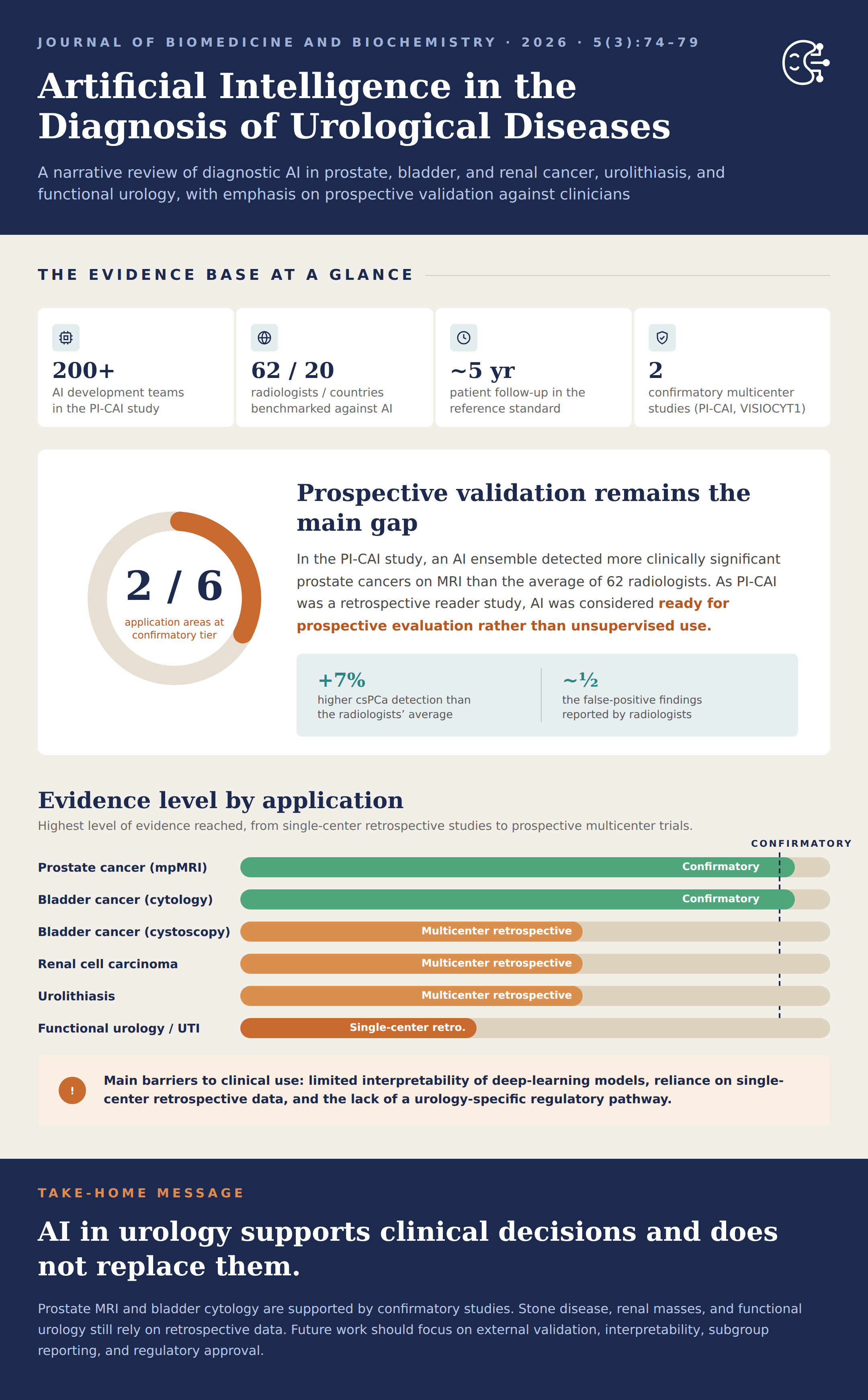
AI has made progress quicker in urology compared to other surgical fields due to prostate imaging, bladder cytology, stone classification, and urodynamic assessment producing the types of structured data that machine learning algorithms work best on. This narrative review takes stock of where diagnostic AI actually stands across four areas of urological practice prostate cancer, bladder cancer, urolithiasis, and functional or infectious disorders of the lower urinary tract and asks a question that is often glossed over in enthusiastic overviews of the field: how much of this evidence has actually been tested prospectively against clinicians, rather than only benchmarked against a retrospective dataset? Prostate cancer detection on MRI has the strongest claim to an answer, following an international confirmatory study (PI-CAI) that pitted AI systems directly against a large panel of radiologists. Bladder cancer has a comparable, if smaller, body of prospective evidence in AI-assisted urinary cytology. Stone disease and functional urology, by contrast, remain almost entirely at the retrospective, single- or two-center stage. We argue that the central obstacle to clinical adoption is no longer diagnostic accuracy, which is already respectable in most published models, but the slower and less glamorous work of external validation, interpretability, and regulatory clearance.
Keywords
Article Details
Copyright (c) 2026 Thaer Saleh Sabor Al-Omary, Samer Lateef Salih*, Husam Al-hraishawi* (Author)

This work is licensed under a Creative Commons Attribution 4.0 International License.
How to Cite


References
- Saha A, Bosma JS, Twilt JJ, van Ginneken B, Bjartell A, Padhani AR, et al. Artificial intelligence and radiologists in prostate cancer detection on MRI (PI-CAI): an international, paired, non-inferiority, confirmatory study. Lancet Oncol. 2024;25(7):879-87. https://doi.org/10.1016/S1470-2045(24)00220-1
- Kelly CJ, Karthikesalingam A, Suleyman M, Corrado G, King D. Key challenges for delivering clinical impact with artificial intelligence. BMC Med. 2019;17:195. https://doi.org/10.1186/s12916-019-1426-2
- Eklund M. Artificial intelligence for scoring prostate MRI: ready for prospective evaluation. Lancet Oncol. 2024;25(7):827-8. https://doi.org/10.1016/S1470-2045(24)00284-5
- Bulten W, Kartasalo K, Chen PHC, Ström P, Pinckaers H, Nagpal K, et al. Artificial intelligence for diagnosis and Gleason grading of prostate cancer: the PANDA challenge. Nat Med. 2022;28(1):154-63. https://doi.org/10.1038/s41591-021-01620-2
- Lebret T, Paoletti X, Pignot G, Roumiguié M, Colombel M, Savareux L, et al. Artificial intelligence to improve cytology performance in urothelial carcinoma diagnosis: results from validation phase of the French, multicenter, prospective VISIOCYT1 trial. World J Urol. 2023;41(9):2381-8. https://doi.org/10.1007/s00345-023-04519-4
- Wang Z, Zhang X, Wang X, Li J, Zhang Y, Zhang T, et al. Deep learning techniques for imaging diagnosis of renal cell carcinoma: current and emerging trends. Front Oncol. 2023;13:1152622. https://doi.org/10.3389/fonc.2023.1152622
- Chandramohan D, Garapati HN, Nangia U, Simhadri PK, Lapsiwala B, Jena NK, et al. Diagnostic accuracy of deep learning in detection and prognostication of renal cell carcinoma: a systematic review and meta-analysis. Front Med (Lausanne). 2024;11:1447057. https://doi.org/10.3389/fmed.2024.1447057
- Abraham A, Kavoussi NL, Sui W, Bejan C, Capra JA, Hsi R. Machine learning prediction of kidney stone composition using electronic health record-derived features. J Endourol. 2022;36(2):243-50. https://doi.org/10.1089/end.2021.0211
- Chmiel JA, Stuivenberg GA, Wong JFW, Nott L, Burton JP, Razvi H, et al. Predictive modeling of urinary stone composition using machine learning and clinical data: implications for treatment strategies and pathophysiological insights. J Endourol. 2024;38(8):778-87. https://doi.org/10.1089/end.2023.0446
- Mei H, Wang Z, Zheng Q, Jiao P, Lv S, Liu X, et al. Deep learning and numerical analysis for bladder outflow obstruction and detrusor underactivity diagnosis in men: a novel urodynamic evaluation scheme. Neurourol Urodyn. 2025;44(2):512-9. https://doi.org/10.1002/nau.25665
- Liu X, Zhong P, Gao Y, Liao L. Applications of machine learning in urodynamics: a narrative review. Neurourol Urodyn. 2024;43(7):1617-25. https://doi.org/10.1002/nau.25490
- Almarie B, Gonzalez-Gonzalez LF, Dos Santos Barbosa LA, Lutz A, Grosse U, Fregni F. Machine learning-enabled medical devices authorized by the US Food and Drug Administration in 2024: regulatory characteristics, predicate lineage, and transparency reporting. Biomedicines. 2025;13(12):3005. https://doi.org/10.3390/biomedicines13123005
- U.S. Food and Drug Administration. Artificial intelligence-enabled medical devices [Internet]. Silver Spring (MD): FDA; 2026 [cited 2026 Sep 28]. Available from: https://www.fda.gov/medical-devices/software-medical-device-samd/artificial-intelligence-and-machine-learning-aiml-enabled-medical-devices
- Char DS, Shah NH, Magnus D. Implementing machine learning in health care: addressing ethical challenges. N Engl J Med. 2018;378(11):981-3. https://doi.org/10.1056/NEJMp1714229
References
Saha A, Bosma JS, Twilt JJ, van Ginneken B, Bjartell A, Padhani AR, et al. Artificial intelligence and radiologists in prostate cancer detection on MRI (PI-CAI): an international, paired, non-inferiority, confirmatory study. Lancet Oncol. 2024;25(7):879-87. https://doi.org/10.1016/S1470-2045(24)00220-1
Kelly CJ, Karthikesalingam A, Suleyman M, Corrado G, King D. Key challenges for delivering clinical impact with artificial intelligence. BMC Med. 2019;17:195. https://doi.org/10.1186/s12916-019-1426-2
Eklund M. Artificial intelligence for scoring prostate MRI: ready for prospective evaluation. Lancet Oncol. 2024;25(7):827-8. https://doi.org/10.1016/S1470-2045(24)00284-5
Bulten W, Kartasalo K, Chen PHC, Ström P, Pinckaers H, Nagpal K, et al. Artificial intelligence for diagnosis and Gleason grading of prostate cancer: the PANDA challenge. Nat Med. 2022;28(1):154-63. https://doi.org/10.1038/s41591-021-01620-2
Lebret T, Paoletti X, Pignot G, Roumiguié M, Colombel M, Savareux L, et al. Artificial intelligence to improve cytology performance in urothelial carcinoma diagnosis: results from validation phase of the French, multicenter, prospective VISIOCYT1 trial. World J Urol. 2023;41(9):2381-8. https://doi.org/10.1007/s00345-023-04519-4
Wang Z, Zhang X, Wang X, Li J, Zhang Y, Zhang T, et al. Deep learning techniques for imaging diagnosis of renal cell carcinoma: current and emerging trends. Front Oncol. 2023;13:1152622. https://doi.org/10.3389/fonc.2023.1152622
Chandramohan D, Garapati HN, Nangia U, Simhadri PK, Lapsiwala B, Jena NK, et al. Diagnostic accuracy of deep learning in detection and prognostication of renal cell carcinoma: a systematic review and meta-analysis. Front Med (Lausanne). 2024;11:1447057. https://doi.org/10.3389/fmed.2024.1447057
Abraham A, Kavoussi NL, Sui W, Bejan C, Capra JA, Hsi R. Machine learning prediction of kidney stone composition using electronic health record-derived features. J Endourol. 2022;36(2):243-50. https://doi.org/10.1089/end.2021.0211
Chmiel JA, Stuivenberg GA, Wong JFW, Nott L, Burton JP, Razvi H, et al. Predictive modeling of urinary stone composition using machine learning and clinical data: implications for treatment strategies and pathophysiological insights. J Endourol. 2024;38(8):778-87. https://doi.org/10.1089/end.2023.0446
Mei H, Wang Z, Zheng Q, Jiao P, Lv S, Liu X, et al. Deep learning and numerical analysis for bladder outflow obstruction and detrusor underactivity diagnosis in men: a novel urodynamic evaluation scheme. Neurourol Urodyn. 2025;44(2):512-9. https://doi.org/10.1002/nau.25665
Liu X, Zhong P, Gao Y, Liao L. Applications of machine learning in urodynamics: a narrative review. Neurourol Urodyn. 2024;43(7):1617-25. https://doi.org/10.1002/nau.25490
Almarie B, Gonzalez-Gonzalez LF, Dos Santos Barbosa LA, Lutz A, Grosse U, Fregni F. Machine learning-enabled medical devices authorized by the US Food and Drug Administration in 2024: regulatory characteristics, predicate lineage, and transparency reporting. Biomedicines. 2025;13(12):3005. https://doi.org/10.3390/biomedicines13123005
U.S. Food and Drug Administration. Artificial intelligence-enabled medical devices [Internet]. Silver Spring (MD): FDA; 2026 [cited 2026 Sep 28]. Available from: https://www.fda.gov/medical-devices/software-medical-device-samd/artificial-intelligence-and-machine-learning-aiml-enabled-medical-devices
Char DS, Shah NH, Magnus D. Implementing machine learning in health care: addressing ethical challenges. N Engl J Med. 2018;378(11):981-3. https://doi.org/10.1056/NEJMp1714229