

Article Sidebar
Main Article Content
Abstract
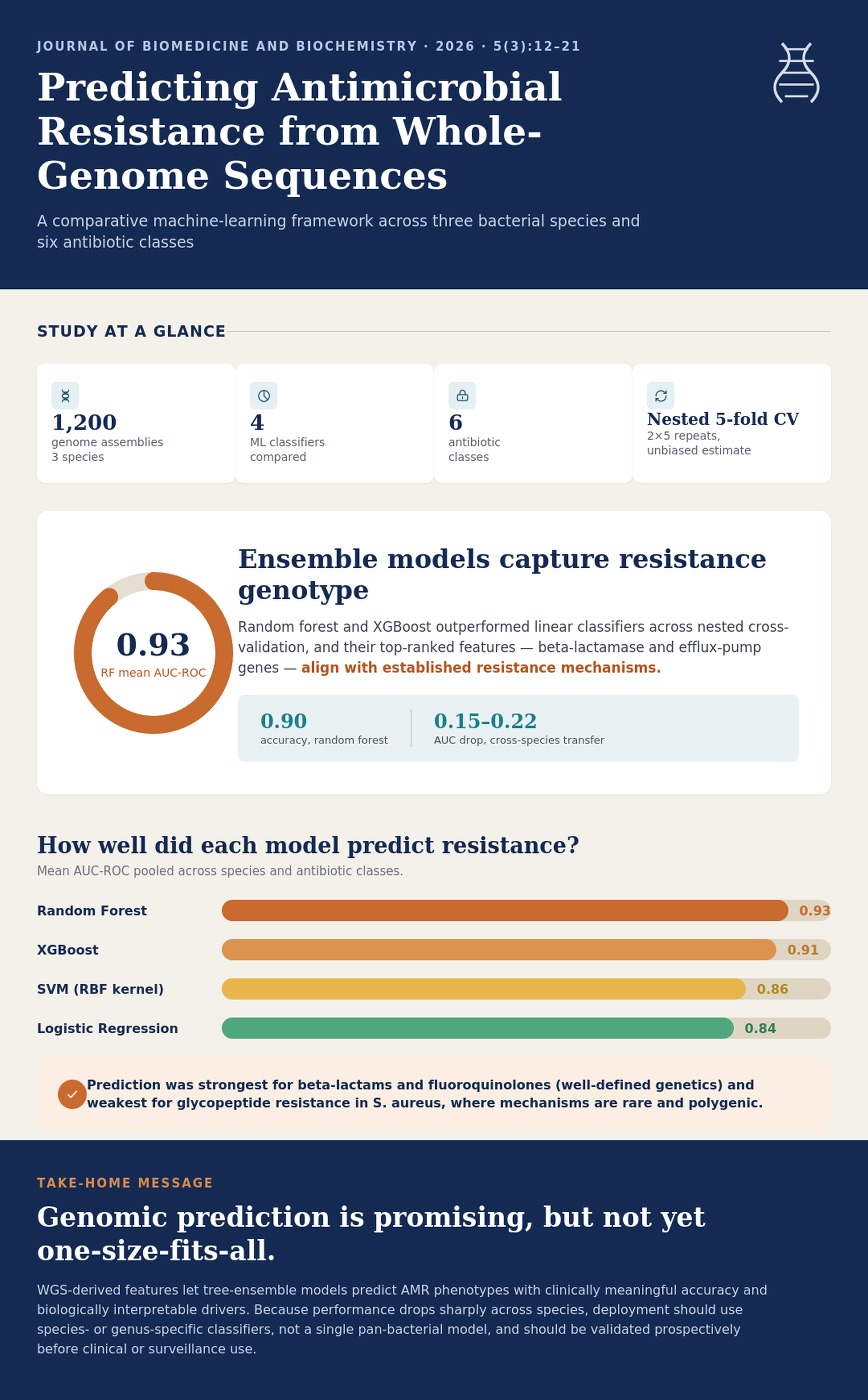
Methods:We have created and evaluated a computational pipeline which extracts k-mer, gene presence-absence, and single nucleotide polymorphism (SNP) features from assembled bacterial genomes and then uses four supervised classifiers (logistic regression, support vector machine [SVM], random forest [RF], and gradient boosted trees [XGBoost]) to predict resistance to six clinically important antibiotic groups in Escherichia coli, Klebsiella pneumoniae, and Staphylococcus aureus strains. Performance of the models was assessed using nested cross-validation and measured with accuracy, sensitivity, specificity, F1 score, and area under the receiver operating characteristic curve (AUC-ROC). The most important features were identified using permutation tests.
Results:Tree ensemble models performed significantly better than linear models, with random forest showing the best mean AUC-ROC of 0.93, and XGBoost the next best with 0.91; logistic regression and SVM peaked at 0.84 and 0.86, respectively. Beta-lactamase and efflux pump genes proved to be the most consistent high-ranking predictors of resistance across different antibiotic classes and bacteria. Predictive power of the models was highest for beta-lactams and fluoroquinolones and poorest for genotyping-poorly defined resistance mechanisms.
Conclusion:Supervised machine learning models based on WGS-derived genomic features provide high-quality predictions of AMR phenotypes and uncover biological predictors of resistance. Independent prospective testing is necessary prior to clinical and surveillance application of these tools.
Keywords
Article Details
Copyright (c) 2026 Ghadah Ali Al-Oudah, Nada Khazal K. Hindi*, Iman Fadhil Abdul-Husin, Sahar Kadhum Abbas, Ahmed M N Al-Ajrash (Author)

This work is licensed under a Creative Commons Attribution 4.0 International License.
How to Cite


References
- World Health Organization. Global antibiotic resistance surveillance report 2025: WHO Global Antimicrobial Resistance and Use Surveillance System (GLASS). Geneva: WHO; 2025.
- Anahtar MN, Yang JH, Kanjilal S. Applications of machine learning to the problem of antimicrobial resistance: an emerging model for translational research. J Clin Microbiol. 2021;59(7):e01260-20. https://doi.org/10.1128/JCM.01260-20
- Ardila CM, Yadalam PK, González-Arroyave D. Integrating whole genome sequencing and machine learning for predicting antimicrobial resistance in critical pathogens: a systematic review of antimicrobial susceptibility tests. PeerJ. 2024;12:e18213. https://doi.org/10.7717/peerj.18213
- Gao Y, Li H, Zhao C, Li S, Yin G, Wang H. Machine learning and feature extraction for rapid antimicrobial resistance prediction of Acinetobacter baumannii from whole-genome sequencing data. Front Microbiol. 2024;14:1320312. https://doi.org/10.3389/fmicb.2023.1320312
- Ahmad A, Hettiarachchi R, Khezri A, Ahluwalia BS, Wadduwage DN, Ahmad R. Highly sensitive quantitative phase microscopy and deep learning aided with whole genome sequencing for rapid detection of infection and antimicrobial resistance. Front Microbiol. 2023;14:1154620. https://doi.org/10.3389/fmicb.2023.1154620
- Yun B, Liao X, Feng J, Ding T. Machine learning-enabled prediction of antimicrobial resistance in foodborne pathogens. CyTA J Food. 2024;22(1):2324024. https://doi.org/10.1080/19476337.2024.2324024
- Wattam AR, Davis JJ, Assaf R, Boisvert S, Brettin T, Bun C, et al. Improvements to PATRIC, the all-bacterial bioinformatics database and analysis resource center. Nucleic Acids Res. 2017;45(D1):D535-D542. https://doi.org/10.1093/nar/gkw1017
- Bolger AM, Lohse M, Usadel B. Trimmomatic: a flexible trimmer for Illumina sequence data. Bioinformatics. 2014;30(15):2114-2120. https://doi.org/10.1093/bioinformatics/btu170
- Bankevich A, Nurk S, Antipov D, Gurevich AA, Dvorkin M, Kulikov AS, et al. SPAdes: a new genome assembly algorithm and its applications to single-cell sequencing. J Comput Biol. 2012;19(5):455-477. https://doi.org/10.1089/cmb.2012.0021
- Gurevich A, Saveliev V, Vyahhi N, Tesler G. QUAST: quality assessment tool for genome assemblies. Bioinformatics. 2013;29(8):1072-1075. https://doi.org/10.1093/bioinformatics/btt086
- Jain C, Rodriguez-R LM, Phillippy AM, Konstantinidis KT, Aluru S. High throughput ANI analysis of 90K prokaryotic genomes reveals clear species boundaries. Nat Commun. 2018;9:5114. https://doi.org/10.1038/s41467-018-07641-9
- Larsen MV, Cosentino S, Rasmussen S, Friis C, Hasman H, Marvig RL, et al. Multilocus sequence typing of total-genome-sequenced bacteria. J Clin Microbiol. 2012;50(4):1355-1361. https://doi.org/10.1128/JCM.06094-11
- Seemann T. ABRicate: mass screening of contigs for antimicrobial resistance genes [software]. 2016. Available from: https://github.com/tseemann/abricate
- Alcock BP, Raphenya AR, Lau TTY, Tsang KK, Bouchard M, Edalatmand A, et al. CARD 2020: antibiotic resistome surveillance with the comprehensive antibiotic resistance database. Nucleic Acids Res. 2020;48(D1):D517-D525. https://doi.org/10.1093/nar/gkz935
- Zankari E, Hasman H, Cosentino S, Vestergaard M, Rasmussen S, Lund O, et al. Identification of acquired antimicrobial resistance genes. J Antimicrob Chemother. 2012;67(11):2640-2644. https://doi.org/10.1093/jac/dks261
- Feldgarden M, Brover V, Haft DH, Prasad AB, Slotta DJ, Tolstoy I, et al. Validating the AMRFinder tool and resistance gene database by using antimicrobial resistance genotype-phenotype correlations in a collection of isolates. Antimicrob Agents Chemother. 2019;63(11):e00483-19. https://doi.org/10.1128/AAC.00483-19
- Seemann T. Snippy: rapid haploid variant calling and core genome alignment [software]. 2015.
- Croucher NJ, Page AJ, Connor TR, Delaney AJ, Keane JA, Bentley SD, et al. Rapid phylogenetic analysis of large samples of recombinant bacterial whole genome sequences using Gubbins. Nucleic Acids Res. 2015;43(3):e15. https://doi.org/10.1093/nar/gku1196
- Breiman L. Random forests. Mach Learn. 2001;45(1):5-32. https://doi.org/10.1023/A:1010933404324
- Chen T, Guestrin C. XGBoost: a scalable tree boosting system. In: Proceedings of the 22nd ACM SIGKDD International Conference on Knowledge Discovery and Data Mining. New York (NY): ACM; 2016. p. 785-794. https://doi.org/10.1145/2939672.2939785
- Chawla NV, Bowyer KW, Hall LO, Kegelmeyer WP. SMOTE: synthetic minority over-sampling technique. J Artif Intell Res. 2002;16:321-357. https://doi.org/10.1613/jair.953
- Pedregosa F, Varoquaux G, Gramfort A, Michel V, Thirion B, Grisel O, et al. Scikit-learn: machine learning in Python. J Mach Learn Res. 2011;12:2825-2830.
References
World Health Organization. Global antibiotic resistance surveillance report 2025: WHO Global Antimicrobial Resistance and Use Surveillance System (GLASS). Geneva: WHO; 2025.
Anahtar MN, Yang JH, Kanjilal S. Applications of machine learning to the problem of antimicrobial resistance: an emerging model for translational research. J Clin Microbiol. 2021;59(7):e01260-20. https://doi.org/10.1128/JCM.01260-20
Ardila CM, Yadalam PK, González-Arroyave D. Integrating whole genome sequencing and machine learning for predicting antimicrobial resistance in critical pathogens: a systematic review of antimicrobial susceptibility tests. PeerJ. 2024;12:e18213. https://doi.org/10.7717/peerj.18213
Gao Y, Li H, Zhao C, Li S, Yin G, Wang H. Machine learning and feature extraction for rapid antimicrobial resistance prediction of Acinetobacter baumannii from whole-genome sequencing data. Front Microbiol. 2024;14:1320312. https://doi.org/10.3389/fmicb.2023.1320312
Ahmad A, Hettiarachchi R, Khezri A, Ahluwalia BS, Wadduwage DN, Ahmad R. Highly sensitive quantitative phase microscopy and deep learning aided with whole genome sequencing for rapid detection of infection and antimicrobial resistance. Front Microbiol. 2023;14:1154620. https://doi.org/10.3389/fmicb.2023.1154620
Yun B, Liao X, Feng J, Ding T. Machine learning-enabled prediction of antimicrobial resistance in foodborne pathogens. CyTA J Food. 2024;22(1):2324024. https://doi.org/10.1080/19476337.2024.2324024
Wattam AR, Davis JJ, Assaf R, Boisvert S, Brettin T, Bun C, et al. Improvements to PATRIC, the all-bacterial bioinformatics database and analysis resource center. Nucleic Acids Res. 2017;45(D1):D535-D542. https://doi.org/10.1093/nar/gkw1017
Bolger AM, Lohse M, Usadel B. Trimmomatic: a flexible trimmer for Illumina sequence data. Bioinformatics. 2014;30(15):2114-2120. https://doi.org/10.1093/bioinformatics/btu170
Bankevich A, Nurk S, Antipov D, Gurevich AA, Dvorkin M, Kulikov AS, et al. SPAdes: a new genome assembly algorithm and its applications to single-cell sequencing. J Comput Biol. 2012;19(5):455-477. https://doi.org/10.1089/cmb.2012.0021
Gurevich A, Saveliev V, Vyahhi N, Tesler G. QUAST: quality assessment tool for genome assemblies. Bioinformatics. 2013;29(8):1072-1075. https://doi.org/10.1093/bioinformatics/btt086
Jain C, Rodriguez-R LM, Phillippy AM, Konstantinidis KT, Aluru S. High throughput ANI analysis of 90K prokaryotic genomes reveals clear species boundaries. Nat Commun. 2018;9:5114. https://doi.org/10.1038/s41467-018-07641-9
Larsen MV, Cosentino S, Rasmussen S, Friis C, Hasman H, Marvig RL, et al. Multilocus sequence typing of total-genome-sequenced bacteria. J Clin Microbiol. 2012;50(4):1355-1361. https://doi.org/10.1128/JCM.06094-11
Seemann T. ABRicate: mass screening of contigs for antimicrobial resistance genes [software]. 2016. Available from: https://github.com/tseemann/abricate
Alcock BP, Raphenya AR, Lau TTY, Tsang KK, Bouchard M, Edalatmand A, et al. CARD 2020: antibiotic resistome surveillance with the comprehensive antibiotic resistance database. Nucleic Acids Res. 2020;48(D1):D517-D525. https://doi.org/10.1093/nar/gkz935
Zankari E, Hasman H, Cosentino S, Vestergaard M, Rasmussen S, Lund O, et al. Identification of acquired antimicrobial resistance genes. J Antimicrob Chemother. 2012;67(11):2640-2644. https://doi.org/10.1093/jac/dks261
Feldgarden M, Brover V, Haft DH, Prasad AB, Slotta DJ, Tolstoy I, et al. Validating the AMRFinder tool and resistance gene database by using antimicrobial resistance genotype-phenotype correlations in a collection of isolates. Antimicrob Agents Chemother. 2019;63(11):e00483-19. https://doi.org/10.1128/AAC.00483-19
Seemann T. Snippy: rapid haploid variant calling and core genome alignment [software]. 2015.
Croucher NJ, Page AJ, Connor TR, Delaney AJ, Keane JA, Bentley SD, et al. Rapid phylogenetic analysis of large samples of recombinant bacterial whole genome sequences using Gubbins. Nucleic Acids Res. 2015;43(3):e15. https://doi.org/10.1093/nar/gku1196
Breiman L. Random forests. Mach Learn. 2001;45(1):5-32. https://doi.org/10.1023/A:1010933404324
Chen T, Guestrin C. XGBoost: a scalable tree boosting system. In: Proceedings of the 22nd ACM SIGKDD International Conference on Knowledge Discovery and Data Mining. New York (NY): ACM; 2016. p. 785-794. https://doi.org/10.1145/2939672.2939785
Chawla NV, Bowyer KW, Hall LO, Kegelmeyer WP. SMOTE: synthetic minority over-sampling technique. J Artif Intell Res. 2002;16:321-357. https://doi.org/10.1613/jair.953
Pedregosa F, Varoquaux G, Gramfort A, Michel V, Thirion B, Grisel O, et al. Scikit-learn: machine learning in Python. J Mach Learn Res. 2011;12:2825-2830.