

Article Sidebar
Main Article Content
Abstract
Background: In Thi-Qar Governorate, southern Iraq, where nutritional deficiencies are common, the interplay between nutritional status, immune competence, and viral disease severity remains poorly characterised.
Objective: To assess the association between nutritional biomarkers, immunological parameters, and the clinical severity of viral infections in adults in Thi-Qar Governorate.
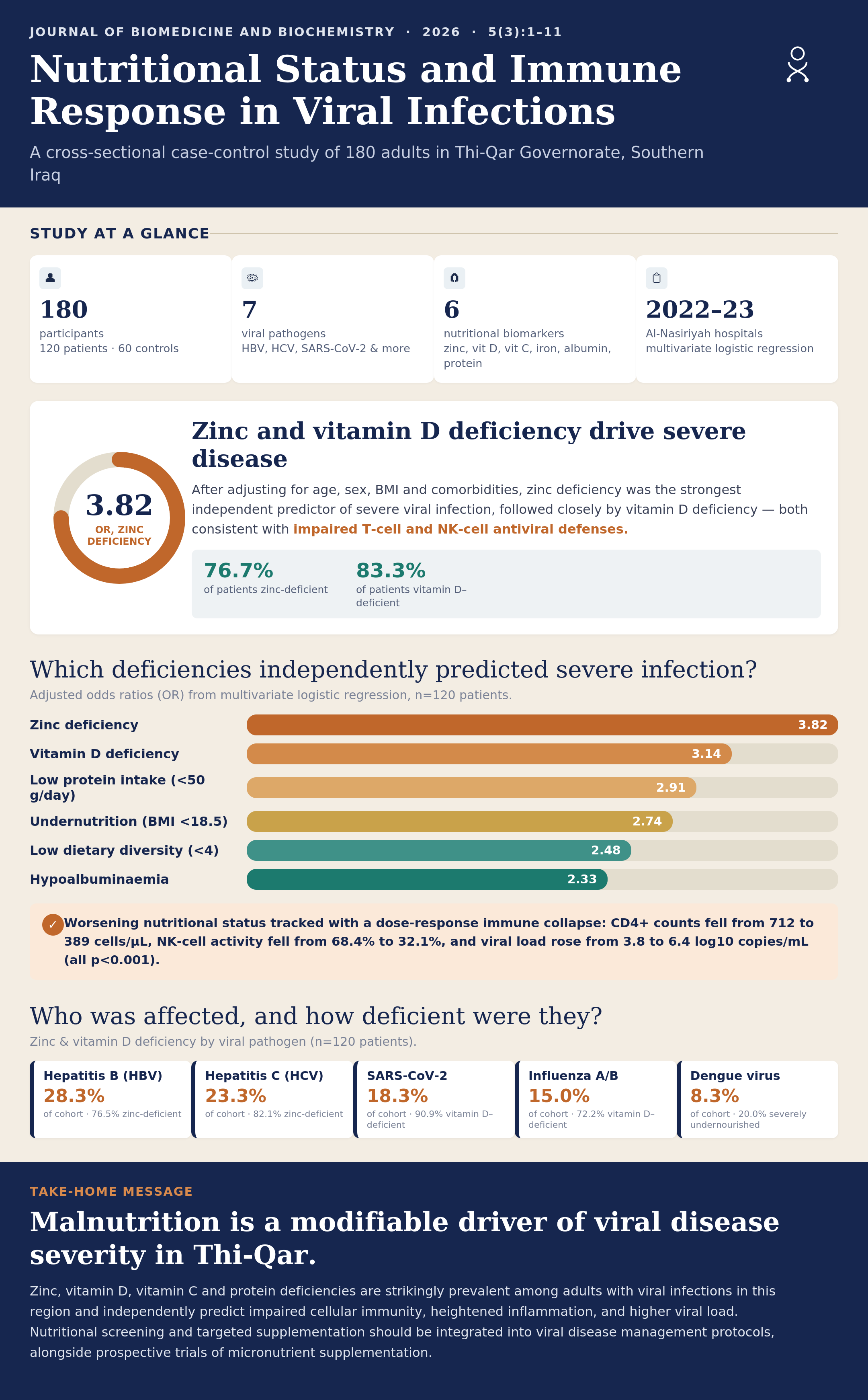
Methods: In a cross-sectional study (January 2022–December 2023), 120 virologically confirmed adult patients and 60 age- and sex-matched healthy controls underwent nutritional assessment (anthropometry, 24-hour dietary recall, Dietary Diversity Score, and serum zinc, vitamin D, vitamin C, iron, and albumin) and immunological evaluation (lymphocyte subsets, immunoglobulins, and inflammatory cytokines). Viral load was quantified by RT-PCR, and independent nutritional predictors of severe infection were identified by multivariate logistic regression.
Results: Compared with controls, patients had significantly lower serum zinc, vitamin D, vitamin C, and albumin, and lower caloric intake and dietary diversity (all p<0.001). Severe deficiency was associated with reduced CD4+ counts (389 ± 134 vs. 712 ± 98 cells/µL), diminished NK-cell activity (32.1% vs. 68.4%), elevated IL-6 (41.3 vs. 12.4 pg/mL), and higher viral loads (6.4 vs. 3.8 log10 copies/mL). Deficiencies of zinc (OR = 3.82, 95% CI 2.14–6.81), vitamin D (OR = 3.14, 95% CI 1.78–5.54), and protein (OR = 2.91, 95% CI 1.62–5.23) were the strongest independent predictors of severe infection.
Conclusions: Deficiencies of zinc, vitamin D, vitamin C, and protein are highly prevalent among virally infected patients in Thi-Qar and are independently associated with impaired cellular immunity and greater viral pathogenicity. Targeted nutritional interventions should be integrated into viral disease management protocols in this region.
Keywords
Article Details
Copyright (c) 2026 Basim Turki Alyousif, Ahmed Aziz Ahmed, Safwan Nadweh*, Mahmood Jamal Abdlhasan (Author)

This work is licensed under a Creative Commons Attribution 4.0 International License.
How to Cite


References
- Bhaskaram P. Micronutrient malnutrition, infection, and immunity: an overview. Nutr Rev. 2002;60(5 Pt 2):S40-5. https://doi.org/10.1301/00296640260130722
- Calder PC. Nutrition, immunity and COVID-19. BMJ Nutr Prev Health. 2020;3(1):74-92. https://doi.org/10.1136/bmjnph-2020-000085
- Alburkat H, Jääskeläinen AJ, Barakat AM, Hasony HJ, Sironen T, Al-Hello H, et al. Lymphocytic choriomeningitis virus infections and seroprevalence, southern Iraq. Emerg Infect Dis. 2020;26(12):3002-6. https://doi.org/10.3201/eid2612.201792
- Musa MD, Ateya HK. Prevalence of overt and occult hepatitis B virus infections among 135 haemodialysis patients attending a haemodialysis centre at Al-Nasiriyah city, Iraq. Iran J Microbiol. 2020;12(5):475-82. https://doi.org/10.18502/ijm.v12i5.4610
- Gombart AF, Pierre A, Maggini S. A review of micronutrients and the immune system—working in harmony to reduce the risk of infection. Nutrients. 2020;12(1):236. https://doi.org/10.3390/nu12010236
- Maggini S, Pierre A, Calder PC. Immune function and micronutrient requirements change over the life course. Nutrients. 2018;10(10):1531. https://doi.org/10.3390/nu10101531
- Shankar AH, Prasad AS. Zinc and immune function: the biological basis of altered resistance to infection. Am J Clin Nutr. 1998;68(2 Suppl):447S-463S. https://doi.org/10.1093/ajcn/68.2.447S
- Rink L, Gabriel P. Zinc and the immune system. Proc Nutr Soc. 2000;59(4):541-52. https://doi.org/10.1017/S0029665100000781
- Martineau AR, Jolliffe DA, Hooper RL, Greenberg L, Aloia JF, Bergman P, et al. Vitamin D supplementation to prevent acute respiratory tract infections: systematic review and meta-analysis of individual participant data. BMJ. 2017;356:i6583. https://doi.org/10.1136/bmj.i6583
- Wintergerst ES, Maggini S, Hornig DH. Immune-enhancing role of vitamin C and zinc and effect on clinical conditions. Ann Nutr Metab. 2006;50(2):85-94. https://doi.org/10.1159/000090495
- Ibrahim MK, Zambruni M, Melby CL, Melby PC. Impact of childhood malnutrition on host defense and infection. Clin Microbiol Rev. 2017;30(4):919-71. https://doi.org/10.1128/CMR.00119-16
- Saunders J, Smith T. Malnutrition: causes and consequences. Clin Med (Lond). 2010;10(6):624-7. https://doi.org/10.7861/clinmedicine.10-6-624
- Soeters PB, Wolfe RR, Shenkin A. Hypoalbuminemia: pathogenesis and clinical significance. JPEN J Parenter Enteral Nutr. 2019;43(2):181-93. https://doi.org/10.1002/jpen.1451
- Gibson RS. Principles of nutritional assessment. 2nd ed. New York: Oxford University Press; 2005. https://doi.org/10.1093/oso/9780195150261.001.0001
- World Health Organization, Food and Agriculture Organization. Vitamin and mineral requirements in human nutrition. 2nd ed. Geneva: World Health Organization; 2004. Available from: https://www.who.int/publications/i/item/9241546123
- Praharaj DL, Anand AC. Nutrition in viral hepatitis. Curr Hepatol Rep. 2023;22(1):9-23. https://doi.org/10.1007/s11901-023-00596-6
- Read SA, Obeid S, Ahlenstiel C, Ahlenstiel G. The role of zinc in antiviral immunity. Adv Nutr. 2019;10(4):696-710. https://doi.org/10.1093/advances/nmz013
- Calder PC, Carr AC, Gombart AF, Eggersdorfer M. Optimal nutritional status for a well-functioning immune system is an important factor to protect against viral infections. Nutrients. 2020;12(4):1181. https://doi.org/10.3390/nu12041181
- Jayawardena R, Sooriyaarachchi P, Chourdakis M, Jeewandara C, Ranasinghe P. Enhancing immunity in viral infections, with special emphasis on COVID-19: a review. Diabetes Metab Syndr. 2020;14(4):367-82. https://doi.org/10.1016/j.dsx.2020.04.015
- Ahsan N, Imran M, Mohammed Y, Al Anouti F, Khan MI, Banerjee T, et al. Mechanistic insight into the role of vitamin D and zinc in modulating immunity against COVID-19: a view from an immunological standpoint. Biol Trace Elem Res. 2023;201(12):5546-60. https://doi.org/10.1007/s12011-023-03620-4
- Rizwan M, Cheng K, Gang Y, Hou Y, Wang C. Immunomodulatory effects of vitamin D and zinc on viral infection. Biol Trace Elem Res. 2025;203(1):1-17. https://doi.org/10.1007/s12011-024-04139-y
References
Bhaskaram P. Micronutrient malnutrition, infection, and immunity: an overview. Nutr Rev. 2002;60(5 Pt 2):S40-5. https://doi.org/10.1301/00296640260130722
Calder PC. Nutrition, immunity and COVID-19. BMJ Nutr Prev Health. 2020;3(1):74-92. https://doi.org/10.1136/bmjnph-2020-000085
Alburkat H, Jääskeläinen AJ, Barakat AM, Hasony HJ, Sironen T, Al-Hello H, et al. Lymphocytic choriomeningitis virus infections and seroprevalence, southern Iraq. Emerg Infect Dis. 2020;26(12):3002-6. https://doi.org/10.3201/eid2612.201792
Musa MD, Ateya HK. Prevalence of overt and occult hepatitis B virus infections among 135 haemodialysis patients attending a haemodialysis centre at Al-Nasiriyah city, Iraq. Iran J Microbiol. 2020;12(5):475-82. https://doi.org/10.18502/ijm.v12i5.4610
Gombart AF, Pierre A, Maggini S. A review of micronutrients and the immune system—working in harmony to reduce the risk of infection. Nutrients. 2020;12(1):236. https://doi.org/10.3390/nu12010236
Maggini S, Pierre A, Calder PC. Immune function and micronutrient requirements change over the life course. Nutrients. 2018;10(10):1531. https://doi.org/10.3390/nu10101531
Shankar AH, Prasad AS. Zinc and immune function: the biological basis of altered resistance to infection. Am J Clin Nutr. 1998;68(2 Suppl):447S-463S. https://doi.org/10.1093/ajcn/68.2.447S
Rink L, Gabriel P. Zinc and the immune system. Proc Nutr Soc. 2000;59(4):541-52. https://doi.org/10.1017/S0029665100000781
Martineau AR, Jolliffe DA, Hooper RL, Greenberg L, Aloia JF, Bergman P, et al. Vitamin D supplementation to prevent acute respiratory tract infections: systematic review and meta-analysis of individual participant data. BMJ. 2017;356:i6583. https://doi.org/10.1136/bmj.i6583
Wintergerst ES, Maggini S, Hornig DH. Immune-enhancing role of vitamin C and zinc and effect on clinical conditions. Ann Nutr Metab. 2006;50(2):85-94. https://doi.org/10.1159/000090495
Ibrahim MK, Zambruni M, Melby CL, Melby PC. Impact of childhood malnutrition on host defense and infection. Clin Microbiol Rev. 2017;30(4):919-71. https://doi.org/10.1128/CMR.00119-16
Saunders J, Smith T. Malnutrition: causes and consequences. Clin Med (Lond). 2010;10(6):624-7. https://doi.org/10.7861/clinmedicine.10-6-624
Soeters PB, Wolfe RR, Shenkin A. Hypoalbuminemia: pathogenesis and clinical significance. JPEN J Parenter Enteral Nutr. 2019;43(2):181-93. https://doi.org/10.1002/jpen.1451
Gibson RS. Principles of nutritional assessment. 2nd ed. New York: Oxford University Press; 2005. https://doi.org/10.1093/oso/9780195150261.001.0001
World Health Organization, Food and Agriculture Organization. Vitamin and mineral requirements in human nutrition. 2nd ed. Geneva: World Health Organization; 2004. Available from: https://www.who.int/publications/i/item/9241546123
Praharaj DL, Anand AC. Nutrition in viral hepatitis. Curr Hepatol Rep. 2023;22(1):9-23. https://doi.org/10.1007/s11901-023-00596-6
Read SA, Obeid S, Ahlenstiel C, Ahlenstiel G. The role of zinc in antiviral immunity. Adv Nutr. 2019;10(4):696-710. https://doi.org/10.1093/advances/nmz013
Calder PC, Carr AC, Gombart AF, Eggersdorfer M. Optimal nutritional status for a well-functioning immune system is an important factor to protect against viral infections. Nutrients. 2020;12(4):1181. https://doi.org/10.3390/nu12041181
Jayawardena R, Sooriyaarachchi P, Chourdakis M, Jeewandara C, Ranasinghe P. Enhancing immunity in viral infections, with special emphasis on COVID-19: a review. Diabetes Metab Syndr. 2020;14(4):367-82. https://doi.org/10.1016/j.dsx.2020.04.015
Ahsan N, Imran M, Mohammed Y, Al Anouti F, Khan MI, Banerjee T, et al. Mechanistic insight into the role of vitamin D and zinc in modulating immunity against COVID-19: a view from an immunological standpoint. Biol Trace Elem Res. 2023;201(12):5546-60. https://doi.org/10.1007/s12011-023-03620-4
Rizwan M, Cheng K, Gang Y, Hou Y, Wang C. Immunomodulatory effects of vitamin D and zinc on viral infection. Biol Trace Elem Res. 2025;203(1):1-17. https://doi.org/10.1007/s12011-024-04139-y