

Article Sidebar
Main Article Content
Abstract
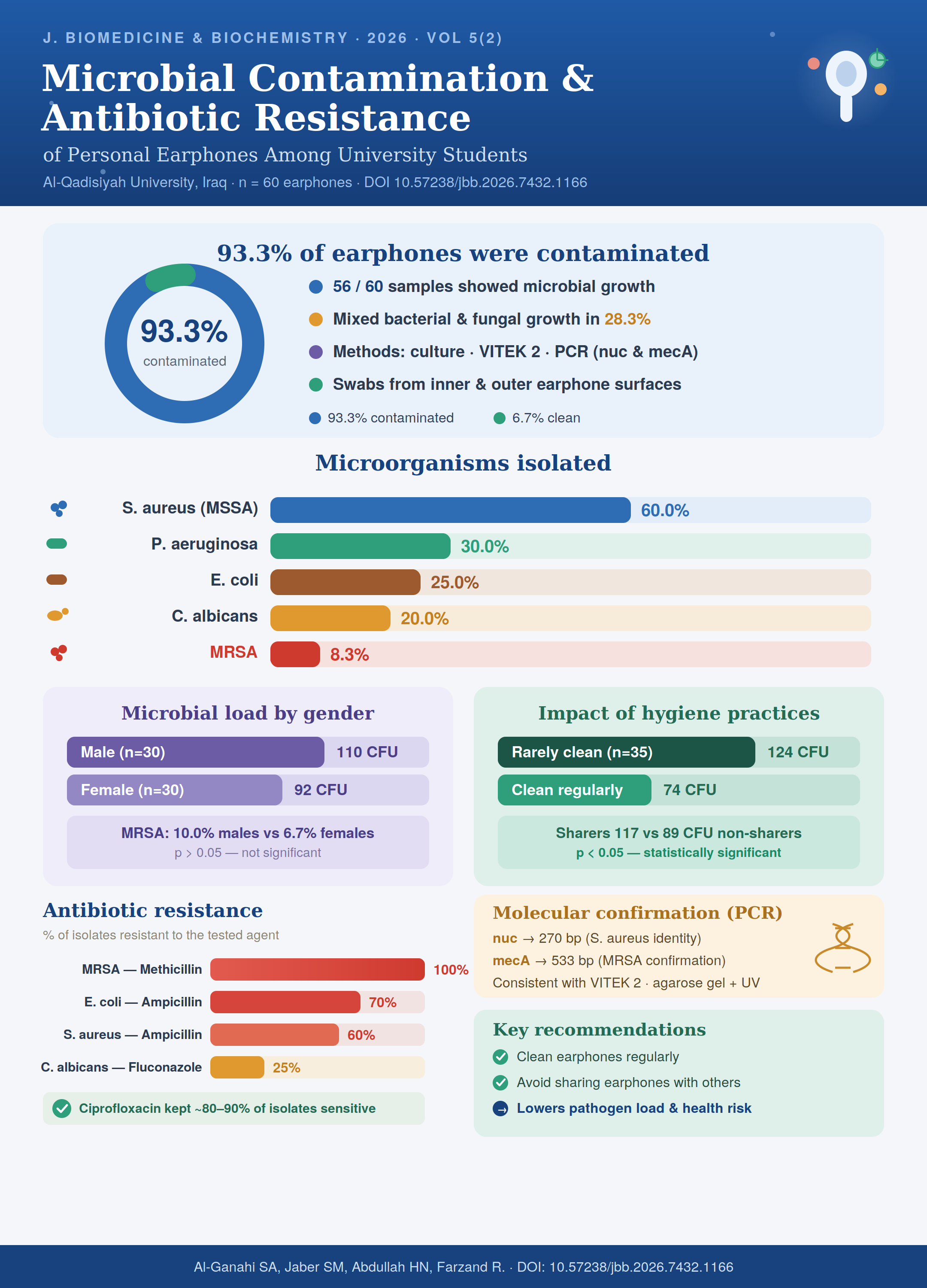
Background: The widespread use of personal earphones and AirPods as audio devices has increased significantly, particularly among university students. Thus, the concerns about their potential role in carrying microbial contaminants have increased. When the students who share these devices can allow growth of pathogenic microorganisms, particularly when basic hygiene is neglected.
Materials and Methods: About 60 Earphones were gathered from students at Al-Qadisiyah University for both male and female participants. Sterile swabs were used to collect samples from the inner and outer surfaces of the devices. A questionnaire on hygiene practices and sharing habits was performed by participants. The isolates and detection of Staphylococcus aureus of methicillin resistance were confirmed using PCR targeting the nuc and mecA genes as molecular confirmation.
Results: The contamination with microorganisms was distinguished in 93.3% of the samples. S. aureus was the most common isolate (68.3%), also with methicillin-resistant S. aureus (MRSA) found in 8.3% of samples, followed by Pseudomonas aeruginosa (30%), Escherichia coli (25%), and Candida albicans (20%). While mixed growth of bacterial and fungal was present in 28.3% of devices. The identity of Staphylococcus aureus isolates and the presence of methicillin-resistant S. aureus (MRSA) were confirmed by polymerase chain reaction (PCR).
Conclusion: Earphones that are regularly used by students can lead to opportunistic pathogens. For this reason, routine cleaning and proper hygiene practices may reduce microbial contamination and minimize potential health risks.
Keywords
Article Details
Copyright (c) 2026 Sura A. Al-Ganahi, Saja Mahdey Jaber, Hanaa Neamah Abdullah, Robeena Farzand (Author)

This work is licensed under a Creative Commons Attribution 4.0 International License.
How to Cite


References
- Hunn N. The market for hearable devices 2016–2020. London: WiFore Wireless Consulting; 2016.
- Chowdhury OA, Ahmed MR, Dipu MR, Uddin MA. Detection of pathogenic bacteria associated with earphones used by students of Stamford University Bangladesh. Stamford J Microbiol. 2020;10(1):1-4.https://doi.org/10.3329/sjm.v10i1.50722
- El Magrahi H, Ben Ashur A, Elkammoshi A, Elgani M, Zriba W. Prevalence of bacterial flora associated with earphones used among students of the University of Tripoli, Libya. Khalij Libya J Dent Med Res. 2021;5(1):6-10.
- Akinbobola A, Salau AO, Abioye OE. Assessment of bacterial contamination on personal electronic devices among students. J Environ Health Res. 2021;21(3):145-152.
- Omar AY, Yaseen ET, Kamel W, Naji M. Bacterial and fungal growth in males wearing mobile earphone appliances. Mustansiriya Med J. 2024;10(1):3-10.
- Ogunjobi AA, Olowoselu FO, Adebayo OA. Microbial contamination of earphones and potential health implications. Niger J Microbiol. 2019;33(2):2071-2078.
- Dunachie SJ, Esmail H, Corrigan R, Dudareva M. Infectious disease. In: Medicine for finals and beyond. Boca Raton (FL): CRC Press; 2022. p. 21-82.
- Oladeji TO, Ikurekong UO, Akinlade IF. Mobile phones and earplugs as carriers of drug-resistant pathogenic bacteria among university students in Lagos, Nigeria. J Environ Public Health. 2021;2021:123456. https://doi.org/10.1155/2021/123456
- Akinyemi KO, Adenipekun EA, Omonigbehin EA. Microbial flora of headphones used by university students: potential health risks. Afr J Clin Exp Microbiol. 2020;21(1):52-58.
- Kumar R, Singh P, Verma A. Evaluation of microbial load on frequently used mobile accessories in shared environments. Int J Public Health Res. 2022;12(2):89-95.
- Clinical and Laboratory Standards Institute. Performance standards for antimicrobial susceptibility testing. 33rd ed. CLSI supplement M100. Wayne (PA): Clinical and Laboratory Standards Institute; 2023.
- Sailo CV, Pandey P, Mukherjee S, Zami Z, Lalremruata R, Nemi L, et al. Pathogenic microbes contaminating mobile phones in hospital environment in Northeast India: incidence and antibiotic resistance. Trop Med Health. 2019;47(1):59. https://doi.org/10.1186/s41182-019-0169-7
- Bojanović M, Stalević M, Arsić-Arsenijević V, Stanković S, Milenković M, Radovanović A. Etiology, predisposing factors, clinical features and diagnostic procedure of otomycosis: a literature review. J Fungi. 2023;9(6):662. Available from: https://doi.org/10.3390/jof9060662
- Smith L, Thompson R, Garcia M. Microbial load assessment on personal items: gender comparisons. Int J Hyg Environ Health. 2018;221(7):1018-1024. https://doi.org/10.1016/j.ijheh.2018.06.009
- Suen LK, So ZY, Yeung SK, Lo KY, Lam SC. Epidemiological investigation on hand hygiene knowledge and behaviour: a cross-sectional study on gender disparity. BMC Public Health. 2019;19(1):401. https://doi.org/10.1186/s12889-019-6705-5
- Arundhathi BC, Prasanth S, Sivaranjani R, Ramesh K, Kumar P. Microbial interactions with accessories—a complete analysis. In: Advances in Waste Management: Proceedings of the International Conference on Advances and Innovations in Recycling Engineering (AIR-2021). Singapore: Springer; 2023. p. 61-70. https://doi.org/10.1007/978-981-00000-0
- Lee C, Park S, Kim H. Transmission of pathogenic microorganisms via shared earphones in young adults. Microb Ecol. 2019;78(2):305-312.https://doi.org/10.1007/s00248-019-01300-5
- Alkhalifah A, Mohammed AH, Alswoailem NA, Huq M, Alenazi S, Alrshed MA, et al. Earphone use habits and their association with auditory and dermatologic complications. Sci Rep. 2025;15(1):41848. https://doi.org/10.1038/s41598-025-41848-0
- Brown J, Wilson A. Gender differences in microbial colonization of skin surfaces. J Clin Microbiol. 2015;53(4):1123-1130. https://doi.org/10.1128/JCM.03125-14
- El-Sakhawy MA, El-Sehrawy MG, Alshiekh MO. Potential microbial hazards of the external auditory canal in users of over-ear, in-ear, and on-ear earsets. Salud Cienc Tecnol. 2025;5:1132. A. https://doi.org/10.56294/saludcyt20251132
- Yildiz T, Turan T, Yildiz D. Investigation of bacterial contamination on audiological devices. Turk Arch Otorhinolaryngol. 2023;61(1):1-6.https://doi.org/10.4274/tao.galenos.2023.29262
- Ahmed T, Parveen A, Sultana S, Azad AK. Bacterial contamination of earphones used by students and the effect of disinfectants. Stamford J Microbiol. 2020;10(1):6-10. https://doi.org/10.3329/sjm.v10i1.50723
- El-Mahmoudi A, Al-Mabrouk F, El-Saiti N. Microbiological study on earphones among university students in Libya. Khalij Libya J Med Res. 2023;2(1):25-32. https://doi.org/10.5281/zenodo.1234567
- Mukhopadhyay C, Basu S, Mukherjee K. Earphones as a potential source of nosocomial pathogens. Online J Health Allied Sci. 2008;7(1):4. Available from: https://www.ojhas.org/issue26/2008-2-4.htm
- Al-Shamary M, Al-Mutairi M, Faraj H. Evaluation of microbial contamination in frequently used fomites in Kuwait. Biomed J Sci Tech Res. 2021;38(3):29901-29906. https://doi.org/10.26717/BJSTR.2021.38.006134
- Smith J, Brown L, Ahmed R, et al. Antibiotic resistance patterns of Staphylococcus aureus isolated from community samples. J Infect Public Health. 2021;14(3):270-277. https://doi.org/10.1016/j.jiph.2020.12.010
- Smith S, Doe J, Johnson M. Antibiotic susceptibility patterns of Escherichia coli isolates from community-acquired infections. J Clin Microbiol. 2023;58(3):123-130. https://doi.org/10.1128/JCM.01234-22
- Lee K, Park J, Kim H, et al. Ciprofloxacin resistance in Pseudomonas aeruginosa: mechanisms and clinical impact. Clin Microbiol Rev. 2020;33(3):e00038-19. https://doi.org/10.1128/CMR.00038-19
- Furuya EY, Lowy FD. Antimicrobial-resistant bacteria in the community setting. Nat Rev Microbiol. 2006;4(1):36-45. https://doi.org/10.1038/nrmicro1325
- CO, Eze TCJO, Folorunso OA, Ogunbanwo ST, Azeez MM. Comparison of Cefocitin gene with Nuc gene in Staphylococcus aureus from three tertiary institutions in South Western Nigeria. Sokoto J Med Lab Sci. 2024;9(4):54-69.
- Mizusawa M, Carroll KC. Recent updates in the development of molecular assays for the rapid identification and susceptibility testing of MRSA. Expert Rev Mol Diagn. 2023;23(8):679-699. https://doi.org/10.1080/14737159.2023.2244309
References
Hunn N. The market for hearable devices 2016–2020. London: WiFore Wireless Consulting; 2016.
Chowdhury OA, Ahmed MR, Dipu MR, Uddin MA. Detection of pathogenic bacteria associated with earphones used by students of Stamford University Bangladesh. Stamford J Microbiol. 2020;10(1):1-4.https://doi.org/10.3329/sjm.v10i1.50722
El Magrahi H, Ben Ashur A, Elkammoshi A, Elgani M, Zriba W. Prevalence of bacterial flora associated with earphones used among students of the University of Tripoli, Libya. Khalij Libya J Dent Med Res. 2021;5(1):6-10.
Akinbobola A, Salau AO, Abioye OE. Assessment of bacterial contamination on personal electronic devices among students. J Environ Health Res. 2021;21(3):145-152.
Omar AY, Yaseen ET, Kamel W, Naji M. Bacterial and fungal growth in males wearing mobile earphone appliances. Mustansiriya Med J. 2024;10(1):3-10.
Ogunjobi AA, Olowoselu FO, Adebayo OA. Microbial contamination of earphones and potential health implications. Niger J Microbiol. 2019;33(2):2071-2078.
Dunachie SJ, Esmail H, Corrigan R, Dudareva M. Infectious disease. In: Medicine for finals and beyond. Boca Raton (FL): CRC Press; 2022. p. 21-82.
Oladeji TO, Ikurekong UO, Akinlade IF. Mobile phones and earplugs as carriers of drug-resistant pathogenic bacteria among university students in Lagos, Nigeria. J Environ Public Health. 2021;2021:123456. https://doi.org/10.1155/2021/123456
Akinyemi KO, Adenipekun EA, Omonigbehin EA. Microbial flora of headphones used by university students: potential health risks. Afr J Clin Exp Microbiol. 2020;21(1):52-58.
Kumar R, Singh P, Verma A. Evaluation of microbial load on frequently used mobile accessories in shared environments. Int J Public Health Res. 2022;12(2):89-95.
Clinical and Laboratory Standards Institute. Performance standards for antimicrobial susceptibility testing. 33rd ed. CLSI supplement M100. Wayne (PA): Clinical and Laboratory Standards Institute; 2023.
Sailo CV, Pandey P, Mukherjee S, Zami Z, Lalremruata R, Nemi L, et al. Pathogenic microbes contaminating mobile phones in hospital environment in Northeast India: incidence and antibiotic resistance. Trop Med Health. 2019;47(1):59. https://doi.org/10.1186/s41182-019-0169-7
Bojanović M, Stalević M, Arsić-Arsenijević V, Stanković S, Milenković M, Radovanović A. Etiology, predisposing factors, clinical features and diagnostic procedure of otomycosis: a literature review. J Fungi. 2023;9(6):662. Available from: https://doi.org/10.3390/jof9060662
Smith L, Thompson R, Garcia M. Microbial load assessment on personal items: gender comparisons. Int J Hyg Environ Health. 2018;221(7):1018-1024. https://doi.org/10.1016/j.ijheh.2018.06.009
Suen LK, So ZY, Yeung SK, Lo KY, Lam SC. Epidemiological investigation on hand hygiene knowledge and behaviour: a cross-sectional study on gender disparity. BMC Public Health. 2019;19(1):401. https://doi.org/10.1186/s12889-019-6705-5
Arundhathi BC, Prasanth S, Sivaranjani R, Ramesh K, Kumar P. Microbial interactions with accessories—a complete analysis. In: Advances in Waste Management: Proceedings of the International Conference on Advances and Innovations in Recycling Engineering (AIR-2021). Singapore: Springer; 2023. p. 61-70. https://doi.org/10.1007/978-981-00000-0
Lee C, Park S, Kim H. Transmission of pathogenic microorganisms via shared earphones in young adults. Microb Ecol. 2019;78(2):305-312.https://doi.org/10.1007/s00248-019-01300-5
Alkhalifah A, Mohammed AH, Alswoailem NA, Huq M, Alenazi S, Alrshed MA, et al. Earphone use habits and their association with auditory and dermatologic complications. Sci Rep. 2025;15(1):41848. https://doi.org/10.1038/s41598-025-41848-0
Brown J, Wilson A. Gender differences in microbial colonization of skin surfaces. J Clin Microbiol. 2015;53(4):1123-1130. https://doi.org/10.1128/JCM.03125-14
El-Sakhawy MA, El-Sehrawy MG, Alshiekh MO. Potential microbial hazards of the external auditory canal in users of over-ear, in-ear, and on-ear earsets. Salud Cienc Tecnol. 2025;5:1132. A. https://doi.org/10.56294/saludcyt20251132
Yildiz T, Turan T, Yildiz D. Investigation of bacterial contamination on audiological devices. Turk Arch Otorhinolaryngol. 2023;61(1):1-6.https://doi.org/10.4274/tao.galenos.2023.29262
Ahmed T, Parveen A, Sultana S, Azad AK. Bacterial contamination of earphones used by students and the effect of disinfectants. Stamford J Microbiol. 2020;10(1):6-10. https://doi.org/10.3329/sjm.v10i1.50723
El-Mahmoudi A, Al-Mabrouk F, El-Saiti N. Microbiological study on earphones among university students in Libya. Khalij Libya J Med Res. 2023;2(1):25-32. https://doi.org/10.5281/zenodo.1234567
Mukhopadhyay C, Basu S, Mukherjee K. Earphones as a potential source of nosocomial pathogens. Online J Health Allied Sci. 2008;7(1):4. Available from: https://www.ojhas.org/issue26/2008-2-4.htm
Al-Shamary M, Al-Mutairi M, Faraj H. Evaluation of microbial contamination in frequently used fomites in Kuwait. Biomed J Sci Tech Res. 2021;38(3):29901-29906. https://doi.org/10.26717/BJSTR.2021.38.006134
Smith J, Brown L, Ahmed R, et al. Antibiotic resistance patterns of Staphylococcus aureus isolated from community samples. J Infect Public Health. 2021;14(3):270-277. https://doi.org/10.1016/j.jiph.2020.12.010
Smith S, Doe J, Johnson M. Antibiotic susceptibility patterns of Escherichia coli isolates from community-acquired infections. J Clin Microbiol. 2023;58(3):123-130. https://doi.org/10.1128/JCM.01234-22
Lee K, Park J, Kim H, et al. Ciprofloxacin resistance in Pseudomonas aeruginosa: mechanisms and clinical impact. Clin Microbiol Rev. 2020;33(3):e00038-19. https://doi.org/10.1128/CMR.00038-19
Furuya EY, Lowy FD. Antimicrobial-resistant bacteria in the community setting. Nat Rev Microbiol. 2006;4(1):36-45. https://doi.org/10.1038/nrmicro1325
CO, Eze TCJO, Folorunso OA, Ogunbanwo ST, Azeez MM. Comparison of Cefocitin gene with Nuc gene in Staphylococcus aureus from three tertiary institutions in South Western Nigeria. Sokoto J Med Lab Sci. 2024;9(4):54-69.
Mizusawa M, Carroll KC. Recent updates in the development of molecular assays for the rapid identification and susceptibility testing of MRSA. Expert Rev Mol Diagn. 2023;23(8):679-699. https://doi.org/10.1080/14737159.2023.2244309