

Article Sidebar
Main Article Content
Abstract
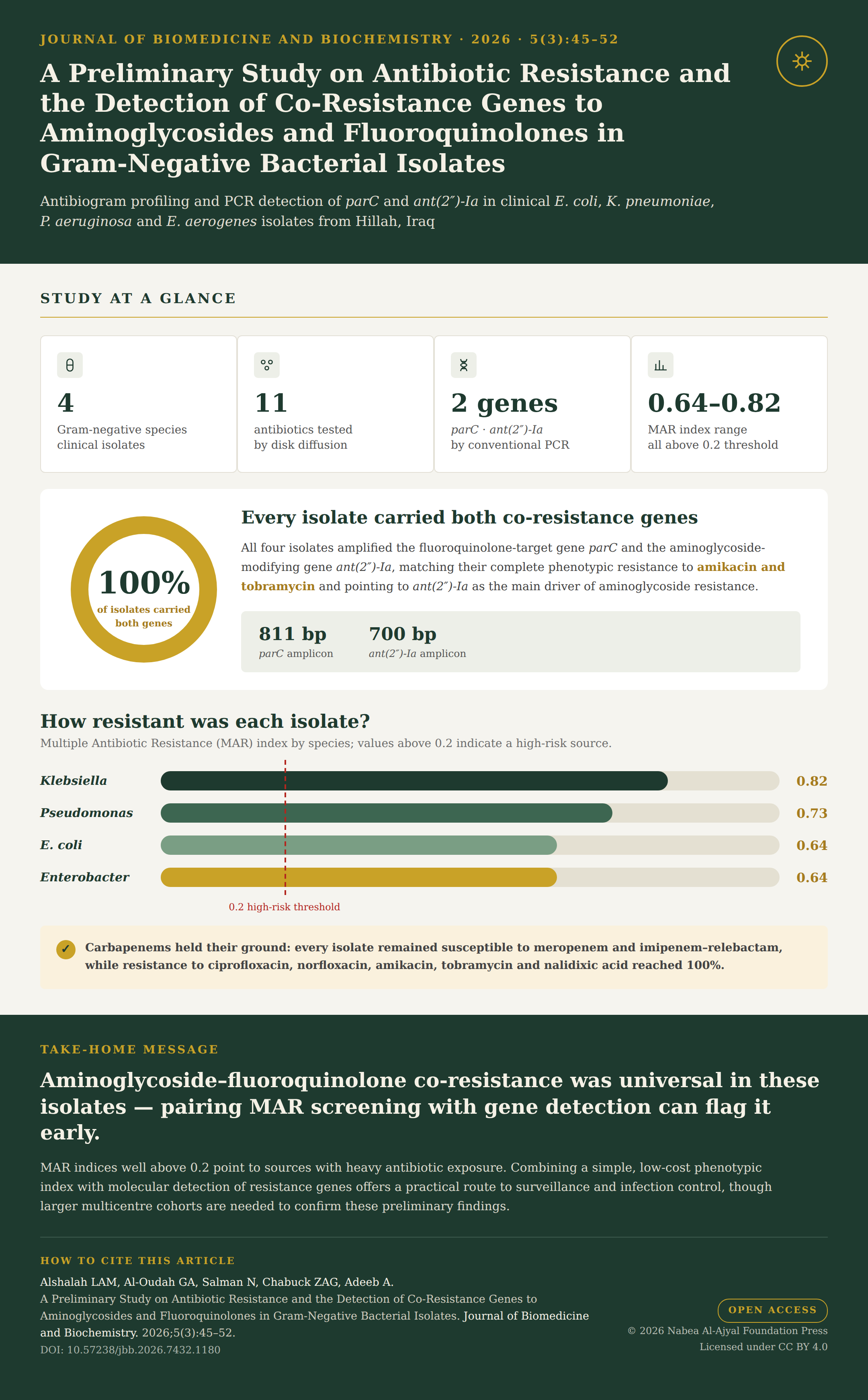
Antibiotic resistance poses a major challenge among pathogenic bacteria, particularly Gram-negative types. Early detection of this resistance is crucial to prevent its horizontal transfer between different bacterial species.This preliminary study aimed to establish the antibiogram and detect specific genes responsible for co-resistance to aminoglycosides and fluoroquinolones commonly found in Gram-negative bacteria.The study evaluated four different clinical species of Gram-negative bacteria: Escherichia coli, Klebsiella pneumoniae, Pseudomonas aeruginosa, and Enterobacter aerogenes.
The susceptibility of these isolates to antibiotics spanning seven antimicrobial categories was determined by measuring inhibition zone diameters using the disk diffusion method. Additionally, the resistance genes parC and ant(2”)-Ia were detected using conventional polymerase chain reaction (PCR).The preliminary findings revealed high resistance percentages across all isolates, ranging from 50% to 100% against most tested antibiotics. The Multiple Antibiotic Resistance (MAR) index exceeded 0.2 for all isolates, ranging between 0.64 and 0.82, though not reaching 1.0.
Furthermore, all isolates were positive for both aminoglycoside and fluoroquinolone resistance genes, highlighting that ant(2”)-Ia is primarily responsible for aminoglycoside resistance in these isolates.
This preliminary study underscores that the MAR index serves as a reliable indicator for the spread of antimicrobial resistance. The molecular identification of resistance genes remains a crucial hallmark for recognizing resistant isolates and implementing effective control measures.
Keywords
Article Details
Copyright (c) 2026 Lubna Abd Muttalib Alshalah, Ghadah Ali Al-Oudah*, Noor Salman, Zainab Adil Ghani Chabuck, Amin Adeeb (Author)

This work is licensed under a Creative Commons Attribution 4.0 International License.
How to Cite


References
- Krause KM, Serio AW, Kane TR, Connolly LE. Aminoglycosides: an overview. Cold Spring Harb Perspect Med. 2016;6(6):a027029. https://doi.org/10.1101/cshperspect.a027029
- Aggen JB, Armstrong ES, Goldblum AA, Dozzo P, Linsell MS, Gliedt MJ, et al. Synthesis and spectrum of the neoglycoside ACHN-490. Antimicrob Agents Chemother. 2010;54(11):4636-42. https://doi.org/10.1128/AAC.00572-10
- Landman D, Babu E, Shah N, Kelly P, Bäcker M, Bratu S, et al. Activity of a novel aminoglycoside, ACHN-490, against clinical isolates of Escherichia coli and Klebsiella pneumoniae from New York City. J Antimicrob Chemother. 2010;65(10):2123-7. https://doi.org/10.1093/jac/dkq278
- Kotra LP, Haddad J, Mobashery S. Aminoglycosides: perspectives on mechanisms of action and resistance and strategies to counter resistance. Antimicrob Agents Chemother. 2000;44(12):3249-56. https://doi.org/10.1128/AAC.44.12.3249-3256.2000
- Shaw KJ, Rather PN, Hare RS, Miller GH. Molecular genetics of aminoglycoside resistance genes and familial relationships of the aminoglycoside-modifying enzymes. Microbiol Rev. 1993;57(1):138-63. https://doi.org/10.1128/mr.57.1.138-163.1993
- Yamane K, Wachino J, Doi Y, Kurokawa H, Arakawa Y. Global spread of multiple aminoglycoside resistance genes. Emerg Infect Dis. 2005;11(6):951-3. https://doi.org/10.3201/eid1106.040924
- Niu H, Yu H, Hu T, Tian G, Zhang L, Guo X, et al. The prevalence of aminoglycoside-modifying enzyme and virulence genes among enterococci with high-level aminoglycoside resistance in Inner Mongolia, China. Braz J Microbiol. 2016;47(3):691-6. https://doi.org/10.1016/j.bjm.2016.04.003
- Bodendoerfer E, Marchesi M, Imkamp F, Courvalin P, Böttger EC, Mancini S. Co-occurrence of aminoglycoside and β-lactam resistance mechanisms in aminoglycoside-non-susceptible Escherichia coli isolated in the Zurich area, Switzerland. Int J Antimicrob Agents. 2020;56(1):106019. https://doi.org/10.1016/j.ijantimicag.2020.106019
- Krumperman PH. Multiple antibiotic resistance indexing of Escherichia coli to identify high-risk sources of fecal contamination of foods. Appl Environ Microbiol. 1983;46(1):165-70. https://doi.org/10.1128/aem.46.1.165-170.1983
- Mthembu MS. The usefulness of multiple antibiotic resistance (MAR) indexing technique in differentiating faecal coliform bacteria from different sources [MSc thesis]. KwaDlangezwa: University of Zululand; 2008.
- Forbes BA, Sahm DF, Weissfeld AS. Bailey & Scott's diagnostic microbiology. 12th ed. St. Louis (MO): Mosby Elsevier; 2007.
- Clinical and Laboratory Standards Institute (CLSI). Performance standards for antimicrobial susceptibility testing. 28th ed. CLSI supplement M100. Wayne (PA): CLSI; 2018.
- Al-Zuhairy A, Al-Dahmoshi H. Aminoglycosides and fluoroquinolones resistance genes among uropathogenic E. coli in Hilla City, Iraq. Drug Invention Today. 2022;13(2).
- Soleimani N, Aganj M, Ali L, Shokoohizadeh L, Sakinç T. Frequency distribution of genes encoding aminoglycoside modifying enzymes in uropathogenic E. coli isolated from Iranian hospital. BMC Res Notes. 2014;7:842. https://doi.org/10.1186/1756-0500-7-842
- Ghadiri H, Vaez H, Khosravi S, Soleymani E. The antibiotic resistance profiles of bacterial strains isolated from patients with hospital-acquired bloodstream and urinary tract infections. Crit Care Res Pract. 2012;2012:890797. https://doi.org/10.1155/2012/890797
- Daini OA, Ogbolu OD, Ogunledun A. Quinolones resistance and R-plasmids of some gram negative enteric bacilli. Afr J Clin Exp Microbiol. 2005;6(1):14-20.
- Yah SC, Yusuf EO, Eghafona NO. Pattern of antibiotic usage by adult populations in the city of Benin, Nigeria. Sci Res Essays. 2008;3(3):81-5.
- Guan S, Xu R, Chen S, Odumeru J, Gyles C. Development of a procedure for discriminating among Escherichia coli isolates from animal and human sources. Appl Environ Microbiol. 2002;68(6):2690-8. https://doi.org/10.1128/AEM.68.6.2690-2698.2002
- Okeke IN, Laxminarayan R, Bhutta ZA, Duse AG, Jenkins P, O'Brien TF, et al. Antimicrobial resistance in developing countries. Part I: recent trends and current status. Lancet Infect Dis. 2005;5(8):481-93. https://doi.org/10.1016/S1473-3099(05)70189-4
- Olayinka AT, Onile BA, Olayinka BO. Antibiotic susceptibility and plasmid pattern of Pseudomonas aeruginosa from the surgical unit of a university teaching hospital in north central Nigeria. Int J Med Med Sci. 2009;1(3):79-83.
- Kim SH, Wei CI, Tzou YM, An H. Multidrug-resistant Klebsiella pneumoniae isolated from farm environments and retail products in Oklahoma. J Food Prot. 2005;68(10):2022-9. https://doi.org/10.4315/0362-028X-68.10.2022
- Lee DS, Lee SJ, Choe HS. Community-acquired urinary tract infection by Escherichia coli in the era of antibiotic resistance. Biomed Res Int. 2018;2018:7656752. https://doi.org/10.1155/2018/7656752
- Khaertynov KS, Anokhin VA, Rizvanov AA, Davidyuk YN, Semyenova DR, Lubin SA, et al. Virulence factors and antibiotic resistance of Klebsiella pneumoniae strains isolated from neonates with sepsis. Front Med (Lausanne). 2018;5:225. https://doi.org/10.3389/fmed.2018.00225
- Eltai NO, Yassine HM, Al Thani AA, Abu Madi MA, Ismail A, Ibrahim E, et al. Prevalence of antibiotic resistant Escherichia coli isolates from fecal samples of food handlers in Qatar. Antimicrob Resist Infect Control. 2018;7:78. https://doi.org/10.1186/s13756-018-0369-2
- Vanhoof R, Nyssen HJ, Van Bossuyt E, Hannecart-Pokorni E. Aminoglycoside resistance in Gram-negative blood isolates from various hospitals in Belgium and the Grand Duchy of Luxembourg. J Antimicrob Chemother. 1999;44(4):483-8. https://doi.org/10.1093/jac/44.4.483
- Samadi N, Pakzad I, Monadi Sefidan A, Hosainzadegan H, Tanomand A. Study of aminoglycoside resistance genes in Enterococcus and Salmonella strains isolated from Ilam and Milad hospitals, Iran. Jundishapur J Microbiol. 2015;8(4):e18102. https://doi.org/10.5812/jjm.18102
- Plattner M, Gysin M, Haldimann K, Becker K, Hobbie SN. Epidemiologic, phenotypic, and structural characterization of aminoglycoside-resistance gene aac(3)-IV. Int J Mol Sci. 2020;21(17):6133. https://doi.org/10.3390/ijms21176133
- Kishk R, Soliman N, Nemr N, Eldesouki R, Mahrous N, Gobouri A, et al. Prevalence of aminoglycoside resistance and aminoglycoside modifying enzymes in Acinetobacter baumannii among intensive care unit patients, Ismailia, Egypt. Infect Drug Resist. 2021;14:143-50. https://doi.org/10.2147/IDR.S290584
- Nasiri G, Peymani A, Farivar TN, Hosseini P. Molecular epidemiology of aminoglycoside resistance in clinical isolates of Klebsiella pneumoniae collected from Qazvin and Tehran provinces, Iran. Infect Genet Evol. 2018;64:219-24.
References
Krause KM, Serio AW, Kane TR, Connolly LE. Aminoglycosides: an overview. Cold Spring Harb Perspect Med. 2016;6(6):a027029. https://doi.org/10.1101/cshperspect.a027029
Aggen JB, Armstrong ES, Goldblum AA, Dozzo P, Linsell MS, Gliedt MJ, et al. Synthesis and spectrum of the neoglycoside ACHN-490. Antimicrob Agents Chemother. 2010;54(11):4636-42. https://doi.org/10.1128/AAC.00572-10
Landman D, Babu E, Shah N, Kelly P, Bäcker M, Bratu S, et al. Activity of a novel aminoglycoside, ACHN-490, against clinical isolates of Escherichia coli and Klebsiella pneumoniae from New York City. J Antimicrob Chemother. 2010;65(10):2123-7. https://doi.org/10.1093/jac/dkq278
Kotra LP, Haddad J, Mobashery S. Aminoglycosides: perspectives on mechanisms of action and resistance and strategies to counter resistance. Antimicrob Agents Chemother. 2000;44(12):3249-56. https://doi.org/10.1128/AAC.44.12.3249-3256.2000
Shaw KJ, Rather PN, Hare RS, Miller GH. Molecular genetics of aminoglycoside resistance genes and familial relationships of the aminoglycoside-modifying enzymes. Microbiol Rev. 1993;57(1):138-63. https://doi.org/10.1128/mr.57.1.138-163.1993
Yamane K, Wachino J, Doi Y, Kurokawa H, Arakawa Y. Global spread of multiple aminoglycoside resistance genes. Emerg Infect Dis. 2005;11(6):951-3. https://doi.org/10.3201/eid1106.040924
Niu H, Yu H, Hu T, Tian G, Zhang L, Guo X, et al. The prevalence of aminoglycoside-modifying enzyme and virulence genes among enterococci with high-level aminoglycoside resistance in Inner Mongolia, China. Braz J Microbiol. 2016;47(3):691-6. https://doi.org/10.1016/j.bjm.2016.04.003
Bodendoerfer E, Marchesi M, Imkamp F, Courvalin P, Böttger EC, Mancini S. Co-occurrence of aminoglycoside and β-lactam resistance mechanisms in aminoglycoside-non-susceptible Escherichia coli isolated in the Zurich area, Switzerland. Int J Antimicrob Agents. 2020;56(1):106019. https://doi.org/10.1016/j.ijantimicag.2020.106019
Krumperman PH. Multiple antibiotic resistance indexing of Escherichia coli to identify high-risk sources of fecal contamination of foods. Appl Environ Microbiol. 1983;46(1):165-70. https://doi.org/10.1128/aem.46.1.165-170.1983
Mthembu MS. The usefulness of multiple antibiotic resistance (MAR) indexing technique in differentiating faecal coliform bacteria from different sources [MSc thesis]. KwaDlangezwa: University of Zululand; 2008.
Forbes BA, Sahm DF, Weissfeld AS. Bailey & Scott's diagnostic microbiology. 12th ed. St. Louis (MO): Mosby Elsevier; 2007.
Clinical and Laboratory Standards Institute (CLSI). Performance standards for antimicrobial susceptibility testing. 28th ed. CLSI supplement M100. Wayne (PA): CLSI; 2018.
Al-Zuhairy A, Al-Dahmoshi H. Aminoglycosides and fluoroquinolones resistance genes among uropathogenic E. coli in Hilla City, Iraq. Drug Invention Today. 2022;13(2).
Soleimani N, Aganj M, Ali L, Shokoohizadeh L, Sakinç T. Frequency distribution of genes encoding aminoglycoside modifying enzymes in uropathogenic E. coli isolated from Iranian hospital. BMC Res Notes. 2014;7:842. https://doi.org/10.1186/1756-0500-7-842
Ghadiri H, Vaez H, Khosravi S, Soleymani E. The antibiotic resistance profiles of bacterial strains isolated from patients with hospital-acquired bloodstream and urinary tract infections. Crit Care Res Pract. 2012;2012:890797. https://doi.org/10.1155/2012/890797
Daini OA, Ogbolu OD, Ogunledun A. Quinolones resistance and R-plasmids of some gram negative enteric bacilli. Afr J Clin Exp Microbiol. 2005;6(1):14-20.
Yah SC, Yusuf EO, Eghafona NO. Pattern of antibiotic usage by adult populations in the city of Benin, Nigeria. Sci Res Essays. 2008;3(3):81-5.
Guan S, Xu R, Chen S, Odumeru J, Gyles C. Development of a procedure for discriminating among Escherichia coli isolates from animal and human sources. Appl Environ Microbiol. 2002;68(6):2690-8. https://doi.org/10.1128/AEM.68.6.2690-2698.2002
Okeke IN, Laxminarayan R, Bhutta ZA, Duse AG, Jenkins P, O'Brien TF, et al. Antimicrobial resistance in developing countries. Part I: recent trends and current status. Lancet Infect Dis. 2005;5(8):481-93. https://doi.org/10.1016/S1473-3099(05)70189-4
Olayinka AT, Onile BA, Olayinka BO. Antibiotic susceptibility and plasmid pattern of Pseudomonas aeruginosa from the surgical unit of a university teaching hospital in north central Nigeria. Int J Med Med Sci. 2009;1(3):79-83.
Kim SH, Wei CI, Tzou YM, An H. Multidrug-resistant Klebsiella pneumoniae isolated from farm environments and retail products in Oklahoma. J Food Prot. 2005;68(10):2022-9. https://doi.org/10.4315/0362-028X-68.10.2022
Lee DS, Lee SJ, Choe HS. Community-acquired urinary tract infection by Escherichia coli in the era of antibiotic resistance. Biomed Res Int. 2018;2018:7656752. https://doi.org/10.1155/2018/7656752
Khaertynov KS, Anokhin VA, Rizvanov AA, Davidyuk YN, Semyenova DR, Lubin SA, et al. Virulence factors and antibiotic resistance of Klebsiella pneumoniae strains isolated from neonates with sepsis. Front Med (Lausanne). 2018;5:225. https://doi.org/10.3389/fmed.2018.00225
Eltai NO, Yassine HM, Al Thani AA, Abu Madi MA, Ismail A, Ibrahim E, et al. Prevalence of antibiotic resistant Escherichia coli isolates from fecal samples of food handlers in Qatar. Antimicrob Resist Infect Control. 2018;7:78. https://doi.org/10.1186/s13756-018-0369-2
Vanhoof R, Nyssen HJ, Van Bossuyt E, Hannecart-Pokorni E. Aminoglycoside resistance in Gram-negative blood isolates from various hospitals in Belgium and the Grand Duchy of Luxembourg. J Antimicrob Chemother. 1999;44(4):483-8. https://doi.org/10.1093/jac/44.4.483
Samadi N, Pakzad I, Monadi Sefidan A, Hosainzadegan H, Tanomand A. Study of aminoglycoside resistance genes in Enterococcus and Salmonella strains isolated from Ilam and Milad hospitals, Iran. Jundishapur J Microbiol. 2015;8(4):e18102. https://doi.org/10.5812/jjm.18102
Plattner M, Gysin M, Haldimann K, Becker K, Hobbie SN. Epidemiologic, phenotypic, and structural characterization of aminoglycoside-resistance gene aac(3)-IV. Int J Mol Sci. 2020;21(17):6133. https://doi.org/10.3390/ijms21176133
Kishk R, Soliman N, Nemr N, Eldesouki R, Mahrous N, Gobouri A, et al. Prevalence of aminoglycoside resistance and aminoglycoside modifying enzymes in Acinetobacter baumannii among intensive care unit patients, Ismailia, Egypt. Infect Drug Resist. 2021;14:143-50. https://doi.org/10.2147/IDR.S290584
Nasiri G, Peymani A, Farivar TN, Hosseini P. Molecular epidemiology of aminoglycoside resistance in clinical isolates of Klebsiella pneumoniae collected from Qazvin and Tehran provinces, Iran. Infect Genet Evol. 2018;64:219-24.