

Article Sidebar
Main Article Content
Abstract
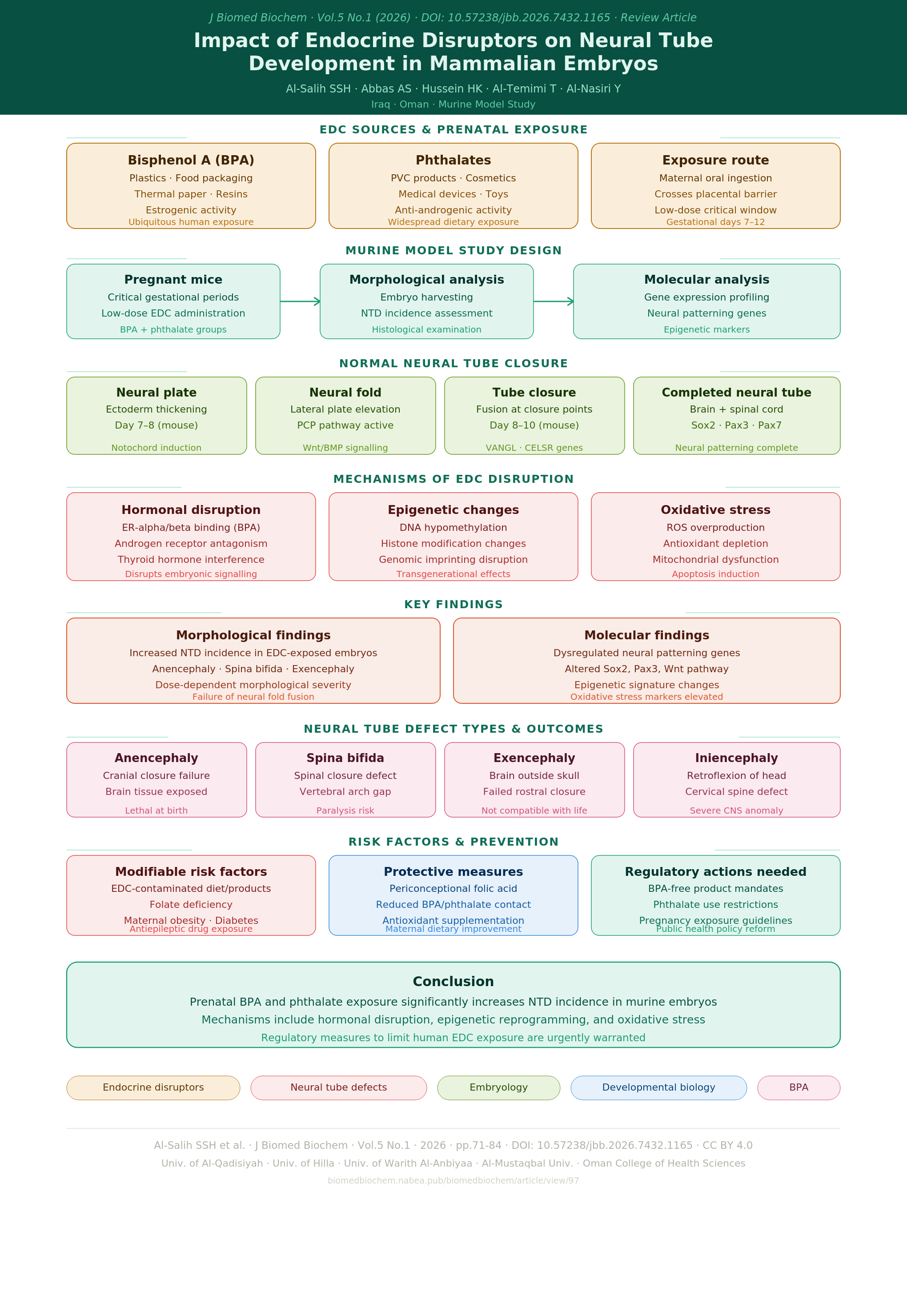
Neural tube defects (NTDs) are severe congenital malformations with multifactorial etiologies, including environmental exposures. This study investigates the effects of prenatal exposure to endocrine-disrupting chemicals (EDCs), specifically bisphenol A (BPA) and phthalates, on neural tube closure in a murine model. Pregnant mice were exposed to low doses of EDCs during critical gestational periods. Morphological assessment and molecular analysis revealed increased incidence of NTDs and dysregulated expression of genes involved in neural patterning. These findings underscore the vulnerability of embryonic development to environmental toxicants and the need for regulatory measures to limit human exposure.
Keywords
Article Details
Copyright (c) 2026 Sadiq Salam H. Al-Salih, Ahmed Saleem Abbas, Hussein Kadhim Hussein, Tiba Al Temimi, Yusra Al Nasiri (Author)

This work is licensed under a Creative Commons Attribution 4.0 International License.
How to Cite


References
- Derghal A, Djelloul M, Trouslard J, Mounien L. Bisphenol A alters early hypothalamic development in mammals. Front Neurosci. 2016;10:318. https://doi.org/10.3389/fnins.2016.00318.
- Laforgia V, Falco D. Endocrine disruptors and developmental neurotoxicity. In: Endocrine Disruptors and Human Health. IntechOpen; 2018. https://doi.org/10.5772/intechopen.76013.
- Toledano JM, Martínez-Rodríguez G, et al. Maternal nutrition, endocrine disruptors, and neural development. Nutrients. 2024;16(11):1556. https://doi.org/10.3390/nu16111556.
- Lucaccioni L, Trevisani V, Marrozzini L, et al. Endocrine-disrupting chemicals and fetal programming. Int J Mol Sci. 2021;22(8):4063. https://doi.org/10.3390/ijms22084063.
- Negri-Cesi P. Bisphenol A and the developing brain: endocrine disruptor effects. Dose Response. 2015;13(2):1559325815590394. https://doi.org/10.1177/1559325815590394.
- Naveau E, Nicolas N, et al. Neural tube morphogenesis and environmental disruption. PLoS One. 2014;9(3):e91903. https://doi.org/10.1371/journal.pone.0091903.
- Bjørling-Poulsen M, Andersen HR, Grandjean P. Potential developmental neurotoxicity of endocrine disruptors. Environ Health. 2008;7:50. https://doi.org/10.1186/1476-069X-7-50.
- Bevan CL, Porter DM, et al. Developmental toxicity and endocrine disruptors. Environ Health Perspect. 2003;111(3):389-394. https://doi.org/10.1289/ehp.5451.
- Susiarjo M, Sasson I, et al. Bisphenol A exposure disrupts genomic imprinting. PLoS Genet. 2013;9(4):e1003401. https://doi.org/10.1371/journal.pgen.1003401.
- Zhang XZ, Wang YY, et al. Epigenetic regulation in neural tube defects. Front Cell Neurosci. 2022;16:888152. https://doi.org/10.3389/fncel.2022.888152.
- Hutt KJ, et al. Oxidative stress pathways in developmental abnormalities. BMC Dev Biol. 2008;8:1. https://doi.org/10.1186/1471-213X-8-1.
- Habert R, et al. Endocrine disruptors and developmental windows. Reproduction. 2014;147(6):R119-R135. https://doi.org/10.1530/REP-13-0571.
- Juriloff DM, Harris MJ. Mouse models of neural tube defects and gene-environment interactions. J Dev Biol. 2018;6(3):22. https://doi.org/10.3390/jdb6030022.
- Kandilya D, et al. DNA methylation signatures in neural tube closure defects. Sci Rep. 2020;10:72719. https://doi.org/10.1038/s41598-020-72719-x.
- Hahn ME, et al. Oxidative stress signaling in embryotoxicity. Free Radic Biol Med. 2015;89:115-129. https://doi.org/10.1016/j.freeradbiomed.2015.04.030.
- Guillette LJ Jr. Endocrine disrupting contaminants and developmental consequences. Environ Health Perspect. 2006;114(Suppl 1):9-12. https://doi.org/10.1289/ehp.8062.
- Bourguignon JP, Parent AS. Early homeostatic disruption and developmental programming. Curr Opin Pediatr. 2010;22(4):470-477. https://doi.org/10.1097/MOP.0b013e32833b584a.
- Isaković J, et al. Experimental models for endocrine disruptor developmental toxicity. Biomedicines. 2022;10(5):965. https://doi.org/10.3390/biomedicines10050965.
- Sutherland A, et al. Morphogenesis and neural tube closure. Semin Cell Dev Biol. 2020;100:145-154. https://doi.org/10.1016/j.semcdb.2019.11.015.
- Lee S, Gleeson JG. Neural tube development and neurogenetic disorders. Trends Neurosci. 2020;43(8):563-576. https://doi.org/10.1016/j.tins.2020.04.009.
- Brooks ER, et al. Cell polarity and convergent extension in neural development. eLife. 2020;9:e60234. https://doi.org/10.7554/eLife.60234.
- Ashokkumar D, et al. Wnt and RA pathways in neurulation. Development. 2020;147(18):dev186999. https://doi.org/10.1242/dev.186999.
- Heusinkveld HJ, et al. Developmental neurotoxicity of endocrine disruptors. Reprod Toxicol. 2021;100:1-10. https://doi.org/10.1016/j.reprotox.2020.12.012.
- Kakebeen AD, Niswander L. Neural tube closure mechanisms in mammals. Genesis. 2021;59(3-4):e23455. https://doi.org/10.1002/dvg.23455.
- Gore AC, Chappell VA, Fenton SE, et al. EDC-2: The Endocrine Society's second scientific statement on endocrine-disrupting chemicals. Endocr Rev. 2015;36(6):E1-E150. https://doi.org/10.1210/er.2015-1010.
- Schug TT, Janesick A, Blumberg B, Heindel JJ. Endocrine disrupting chemicals and disease susceptibility. J Steroid Biochem Mol Biol. 2011;127(3-5):204-215. https://doi.org/10.1016/j.jsbmb.2011.03.015.
- Street ME, Angelini S, et al. Endocrine disruptors and developmental origins of disease. Front Endocrinol (Lausanne). 2018;9:396. https://doi.org/10.3389/fendo.2018.00396.
- Vandenberg LN, Colborn T, Hayes TB, et al. Hormones and endocrine-disrupting chemicals: low-dose effects and nonmonotonic responses. Endocr Rev. 2012;33(3):378-455. https://doi.org/10.1210/er.2011-1050.
- Ziv-Gal A, Flaws JA. Evidence for bisphenol A-induced female reproductive toxicity. Fertil Steril. 2016;106(4):827-856. https://doi.org/10.1016/j.fertnstert.2016.06.018.
- Diamanti-Kandarakis E, Bourguignon JP, Giudice LC, et al. Endocrine-disrupting chemicals: an Endocrine Society scientific statement. Endocr Rev. 2009;30(4):293-342. https://doi.org/10.1210/er.2009-0002.
- Patisaul HB, Adewale HB. Long-term effects of environmental endocrine disruptors on reproductive physiology and behavior. Front Neuroendocrinol. 2009;30(3):315-341. https://doi.org/10.1016/j.yfrne.2009.03.004.
- Manikkam M, et al. Transgenerational actions of endocrine disruptors. PLoS One. 2013;8(7):e66316. https://doi.org/10.1371/journal.pone.0066316.
- Braun JM. Early-life exposure to EDCs and child neurodevelopment. Nat Rev Endocrinol. 2017;13(3):161-173. https://doi.org/10.1038/nrendo.2016.175.
- Crain DA, et al. Female reproductive disorders linked to EDCs. Fertil Steril. 2008;89(2 Suppl):e1-e10. https://doi.org/10.1016/j.fertnstert.2008.01.009.
- Zoeller RT, Brown TR, Doan LL, et al. Endocrine-disrupting chemicals and public health protection: a statement of principles from The Endocrine Society. Endocrinology. 2012;153(9):4097-4110. https://doi.org/10.1210/en.2012-1422.
- Newbold RR, Padilla-Banks E, Jefferson WN. Environmental estrogens and developmental effects. Int J Androl. 2007;30(4):201-208. https://doi.org/10.1111/j.1365-2605.2007.00758.x.
- Woodruff TJ, Zota AR, Schwartz JM. Environmental chemicals in pregnant women in the US. Environ Health Perspect. 2011;119(6):878-885. https://doi.org/10.1289/ehp.1002727.
- Rattan S, et al. Transgenerational inheritance and endocrine disruptors. J Endocrinol. 2017;233(3):R109-R126. https://doi.org/10.1530/JOE-17-0023.
- Heindel JJ, Skalla LA, Joubert BR, et al. Review of developmental origins and endocrine disruptors. Reprod Toxicol. 2015;54:1-6. https://doi.org/10.1016/j.reprotox.2014.10.012.
- Trasande L, Zoeller RT, Hass U, et al. Burden of disease from endocrine-disrupting chemicals in Europe. J Clin Endocrinol Metab. 2015;100(4):1245-1255. https://doi.org/10.1210/jc.2014-4324.
References
Derghal A, Djelloul M, Trouslard J, Mounien L. Bisphenol A alters early hypothalamic development in mammals. Front Neurosci. 2016;10:318. https://doi.org/10.3389/fnins.2016.00318.
Laforgia V, Falco D. Endocrine disruptors and developmental neurotoxicity. In: Endocrine Disruptors and Human Health. IntechOpen; 2018. https://doi.org/10.5772/intechopen.76013.
Toledano JM, Martínez-Rodríguez G, et al. Maternal nutrition, endocrine disruptors, and neural development. Nutrients. 2024;16(11):1556. https://doi.org/10.3390/nu16111556.
Lucaccioni L, Trevisani V, Marrozzini L, et al. Endocrine-disrupting chemicals and fetal programming. Int J Mol Sci. 2021;22(8):4063. https://doi.org/10.3390/ijms22084063.
Negri-Cesi P. Bisphenol A and the developing brain: endocrine disruptor effects. Dose Response. 2015;13(2):1559325815590394. https://doi.org/10.1177/1559325815590394.
Naveau E, Nicolas N, et al. Neural tube morphogenesis and environmental disruption. PLoS One. 2014;9(3):e91903. https://doi.org/10.1371/journal.pone.0091903.
Bjørling-Poulsen M, Andersen HR, Grandjean P. Potential developmental neurotoxicity of endocrine disruptors. Environ Health. 2008;7:50. https://doi.org/10.1186/1476-069X-7-50.
Bevan CL, Porter DM, et al. Developmental toxicity and endocrine disruptors. Environ Health Perspect. 2003;111(3):389-394. https://doi.org/10.1289/ehp.5451.
Susiarjo M, Sasson I, et al. Bisphenol A exposure disrupts genomic imprinting. PLoS Genet. 2013;9(4):e1003401. https://doi.org/10.1371/journal.pgen.1003401.
Zhang XZ, Wang YY, et al. Epigenetic regulation in neural tube defects. Front Cell Neurosci. 2022;16:888152. https://doi.org/10.3389/fncel.2022.888152.
Hutt KJ, et al. Oxidative stress pathways in developmental abnormalities. BMC Dev Biol. 2008;8:1. https://doi.org/10.1186/1471-213X-8-1.
Habert R, et al. Endocrine disruptors and developmental windows. Reproduction. 2014;147(6):R119-R135. https://doi.org/10.1530/REP-13-0571.
Juriloff DM, Harris MJ. Mouse models of neural tube defects and gene-environment interactions. J Dev Biol. 2018;6(3):22. https://doi.org/10.3390/jdb6030022.
Kandilya D, et al. DNA methylation signatures in neural tube closure defects. Sci Rep. 2020;10:72719. https://doi.org/10.1038/s41598-020-72719-x.
Hahn ME, et al. Oxidative stress signaling in embryotoxicity. Free Radic Biol Med. 2015;89:115-129. https://doi.org/10.1016/j.freeradbiomed.2015.04.030.
Guillette LJ Jr. Endocrine disrupting contaminants and developmental consequences. Environ Health Perspect. 2006;114(Suppl 1):9-12. https://doi.org/10.1289/ehp.8062.
Bourguignon JP, Parent AS. Early homeostatic disruption and developmental programming. Curr Opin Pediatr. 2010;22(4):470-477. https://doi.org/10.1097/MOP.0b013e32833b584a.
Isaković J, et al. Experimental models for endocrine disruptor developmental toxicity. Biomedicines. 2022;10(5):965. https://doi.org/10.3390/biomedicines10050965.
Sutherland A, et al. Morphogenesis and neural tube closure. Semin Cell Dev Biol. 2020;100:145-154. https://doi.org/10.1016/j.semcdb.2019.11.015.
Lee S, Gleeson JG. Neural tube development and neurogenetic disorders. Trends Neurosci. 2020;43(8):563-576. https://doi.org/10.1016/j.tins.2020.04.009.
Brooks ER, et al. Cell polarity and convergent extension in neural development. eLife. 2020;9:e60234. https://doi.org/10.7554/eLife.60234.
Ashokkumar D, et al. Wnt and RA pathways in neurulation. Development. 2020;147(18):dev186999. https://doi.org/10.1242/dev.186999.
Heusinkveld HJ, et al. Developmental neurotoxicity of endocrine disruptors. Reprod Toxicol. 2021;100:1-10. https://doi.org/10.1016/j.reprotox.2020.12.012.
Kakebeen AD, Niswander L. Neural tube closure mechanisms in mammals. Genesis. 2021;59(3-4):e23455. https://doi.org/10.1002/dvg.23455.
Gore AC, Chappell VA, Fenton SE, et al. EDC-2: The Endocrine Society's second scientific statement on endocrine-disrupting chemicals. Endocr Rev. 2015;36(6):E1-E150. https://doi.org/10.1210/er.2015-1010.
Schug TT, Janesick A, Blumberg B, Heindel JJ. Endocrine disrupting chemicals and disease susceptibility. J Steroid Biochem Mol Biol. 2011;127(3-5):204-215. https://doi.org/10.1016/j.jsbmb.2011.03.015.
Street ME, Angelini S, et al. Endocrine disruptors and developmental origins of disease. Front Endocrinol (Lausanne). 2018;9:396. https://doi.org/10.3389/fendo.2018.00396.
Vandenberg LN, Colborn T, Hayes TB, et al. Hormones and endocrine-disrupting chemicals: low-dose effects and nonmonotonic responses. Endocr Rev. 2012;33(3):378-455. https://doi.org/10.1210/er.2011-1050.
Ziv-Gal A, Flaws JA. Evidence for bisphenol A-induced female reproductive toxicity. Fertil Steril. 2016;106(4):827-856. https://doi.org/10.1016/j.fertnstert.2016.06.018.
Diamanti-Kandarakis E, Bourguignon JP, Giudice LC, et al. Endocrine-disrupting chemicals: an Endocrine Society scientific statement. Endocr Rev. 2009;30(4):293-342. https://doi.org/10.1210/er.2009-0002.
Patisaul HB, Adewale HB. Long-term effects of environmental endocrine disruptors on reproductive physiology and behavior. Front Neuroendocrinol. 2009;30(3):315-341. https://doi.org/10.1016/j.yfrne.2009.03.004.
Manikkam M, et al. Transgenerational actions of endocrine disruptors. PLoS One. 2013;8(7):e66316. https://doi.org/10.1371/journal.pone.0066316.
Braun JM. Early-life exposure to EDCs and child neurodevelopment. Nat Rev Endocrinol. 2017;13(3):161-173. https://doi.org/10.1038/nrendo.2016.175.
Crain DA, et al. Female reproductive disorders linked to EDCs. Fertil Steril. 2008;89(2 Suppl):e1-e10. https://doi.org/10.1016/j.fertnstert.2008.01.009.
Zoeller RT, Brown TR, Doan LL, et al. Endocrine-disrupting chemicals and public health protection: a statement of principles from The Endocrine Society. Endocrinology. 2012;153(9):4097-4110. https://doi.org/10.1210/en.2012-1422.
Newbold RR, Padilla-Banks E, Jefferson WN. Environmental estrogens and developmental effects. Int J Androl. 2007;30(4):201-208. https://doi.org/10.1111/j.1365-2605.2007.00758.x.
Woodruff TJ, Zota AR, Schwartz JM. Environmental chemicals in pregnant women in the US. Environ Health Perspect. 2011;119(6):878-885. https://doi.org/10.1289/ehp.1002727.
Rattan S, et al. Transgenerational inheritance and endocrine disruptors. J Endocrinol. 2017;233(3):R109-R126. https://doi.org/10.1530/JOE-17-0023.
Heindel JJ, Skalla LA, Joubert BR, et al. Review of developmental origins and endocrine disruptors. Reprod Toxicol. 2015;54:1-6. https://doi.org/10.1016/j.reprotox.2014.10.012.
Trasande L, Zoeller RT, Hass U, et al. Burden of disease from endocrine-disrupting chemicals in Europe. J Clin Endocrinol Metab. 2015;100(4):1245-1255. https://doi.org/10.1210/jc.2014-4324.